Date reflects latest content revision | Updated with Latest syllabus alignment
Table of Contents
Preparing Shakespeare’s Macbeth for ISC English Literature requires much more than simply finding the correct workbook answers. The play is rich in symbolism, psychological conflict, dramatic techniques, and powerful character development, making it one of Shakespeare’s most thought-provoking tragedies. To help students study with confidence, this page brings together complete workbook answers for Acts 1 to 5, along with scene-wise explanations, summaries, important questions, character analysis, themes, literary devices, quotations, and revision resources—all organised in one place.
Whether you’re using the Evergreen, Morning Star, or another ISC-prescribed workbook, this page serves as a central study hub where you can quickly access the required Act, Scene, or exercise without searching through multiple sources. Every solution is written in clear, student-friendly language while maintaining the depth of analysis expected in ISC English Literature examinations. The explanations are designed to help you understand Shakespeare’s ideas rather than simply memorise answers.
In addition to workbook solutions, this resource explores the dramatic significance of important scenes, character motivations, symbolism, soliloquies, and recurring themes that shape the tragedy. By understanding the context behind each event and the literary techniques used by Shakespeare, students can develop stronger analytical skills and write more effective examination answers with confidence.
This page is equally useful for classroom learning, independent revision, homework support, and last-minute examination preparation. Teachers and parents can also use the organised explanations as a reliable reference while discussing important scenes, speeches, and literary concepts from the play. Every section has been structured to make revision easier while encouraging a deeper appreciation of Shakespeare’s writing.
Use this page as your complete companion for ISC Macbeth Workbook Answers and related study material. Simply navigate to the required Act or Scene to explore detailed solutions, strengthen your understanding of the play, and prepare confidently for school assessments, pre-board examinations, and the ISC English Literature examination.
Complete Act-Wise Macbeth Solutions
This page provides organised Act-wise workbook solutions for all five Acts of Shakespeare’s Macbeth, allowing students to study the play in the same sequence as prescribed in the ISC English Literature syllabus. Each Act is further divided into individual Scenes, making it easy to locate specific workbook exercises, extract-based questions, and detailed explanations without searching through multiple pages.
Act 1 Workbook Answers & Solutions
Act 2 Workbook Answers & Solutions
Act 3 Workbook Answers & Solutions
Act 4 And Act 5 Workbook Answers & Solutions
Summary
Multiple Choice Questions
Important Extract-Based Questions
Character And Theme Analysis
All Answers Follow The Latest ICSE English Literature Syllabus And Focus On Clarity, Accuracy, And Proper Answer-Writing Style.
As you progress through the Acts, you’ll witness Macbeth’s transformation from a courageous Scottish nobleman into a tragic ruler consumed by ambition, guilt, and fear. Alongside this journey, the workbook solutions also highlight the changing roles of Lady Macbeth, Banquo, Macduff, Malcolm, and the Witches, helping students understand how each character contributes to the development of Shakespeare’s tragedy. Whether you’re revising a single Scene or preparing the entire play for examinations, the Act-wise structure makes learning systematic, convenient, and more effective.
Get The Official Workbook Home Delivered :
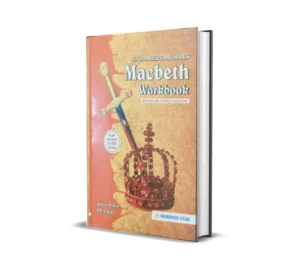
Buy Physical Book On Amazon
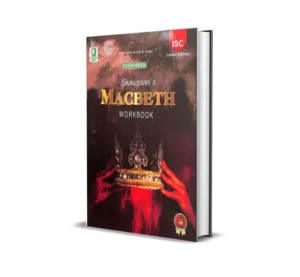
Buy Physical Book On Amazon
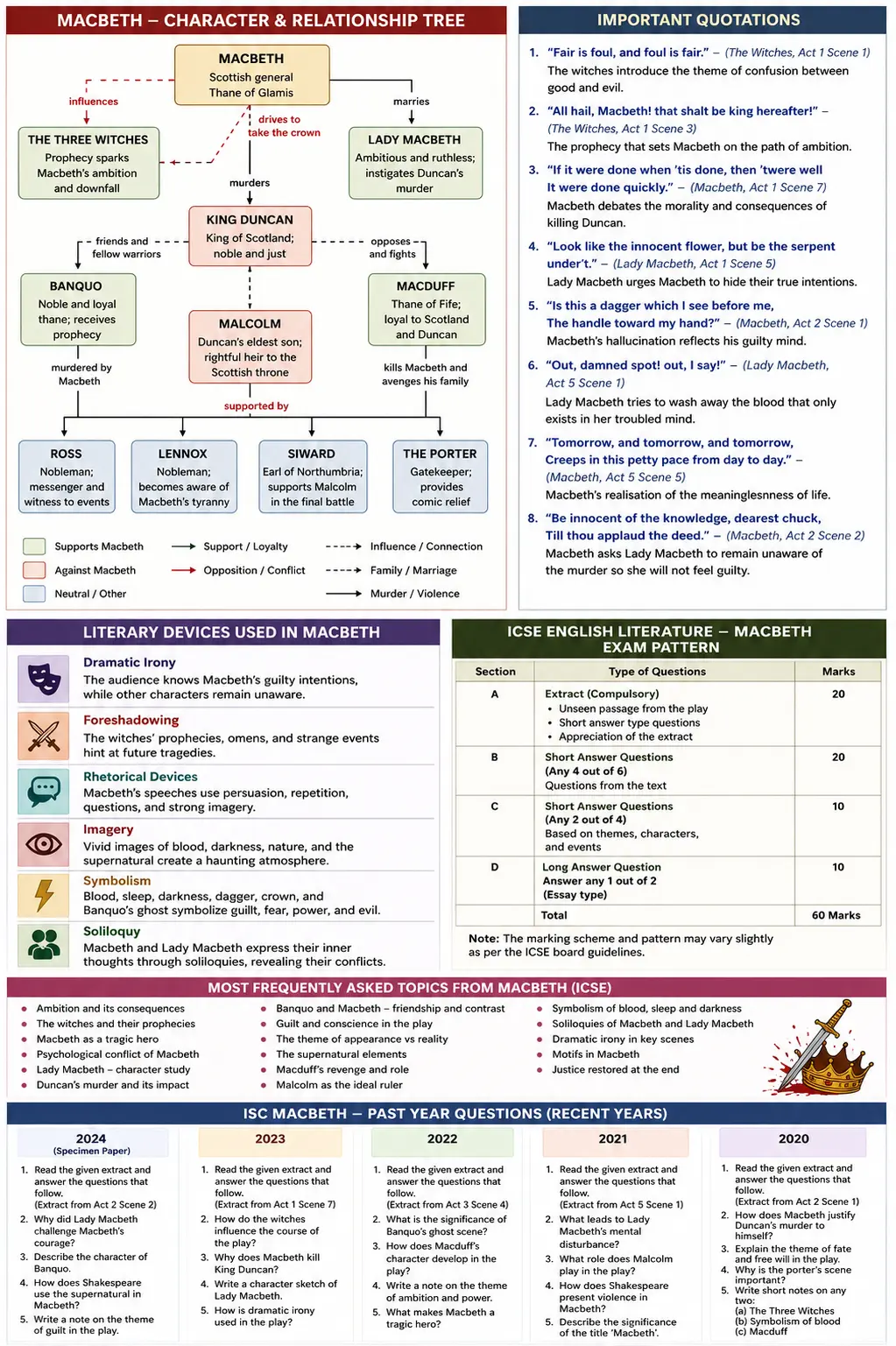
Important Quotations From Macbeth
Shakespeare’s Macbeth contains several memorable quotations that reveal the thoughts, motivations, and psychological conflicts of its characters. Understanding the speaker, dramatic context, and significance of these lines is essential for answering extract-based, character, and theme-related questions in ISC English Literature examinations. The following quotations are among the most important for revision.
Quotation
Speaker
Act & Scene
Literary Significance
“Fair is foul, and foul is fair.”
The Three Witches
Act 1, Scene 1
Introduces the theme of appearance versus reality and establishes the supernatural atmosphere of the play.
“If chance will have me king, why, chance may crown me.”
Macbeth
Act 1, Scene 3
Reveals Macbeth’s first thoughts about destiny and ambition after hearing the witches’ prophecy.
“Stars, hide your fires; Let not light see my black and deep desires.”
Macbeth
Act 1, Scene 4
Highlights Macbeth’s hidden ambition and his awareness that his thoughts are morally wrong.
“Look like the innocent flower, but be the serpent under’t.”
Lady Macbeth
Act 1, Scene 5
Symbolises deception and appearance versus reality, encouraging Macbeth to conceal his true intentions.
“Is this a dagger which I see before me?”
Macbeth
Act 2, Scene 1
Demonstrates Macbeth’s disturbed mental state and foreshadows King Duncan’s murder.
“Will all great Neptune’s ocean wash this blood clean from my hand?”
Macbeth
Act 2, Scene 2
Blood becomes a symbol of guilt, showing Macbeth’s immediate remorse after committing the murder.
“A little water clears us of this deed.”
Lady Macbeth
Act 2, Scene 2
Reflects Lady Macbeth’s practical attitude before guilt gradually destroys her own peace of mind.
“There’s daggers in men’s smiles.”
Donalbain
Act 2, Scene 3
Suggests that appearances can be deceptive and danger often hides beneath outward friendliness.
“O, full of scorpions is my mind.”
Macbeth
Act 3, Scene 2
Illustrates Macbeth’s growing paranoia, fear, and psychological suffering after becoming king.
“Blood will have blood.”
Macbeth
Act 3, Scene 4
Suggests that violence inevitably leads to more violence and revenge.
“Double, double toil and trouble; Fire burn and cauldron bubble.”
The Three Witches
Act 4, Scene 1
Reinforces the supernatural atmosphere and the witches’ influence over Macbeth’s fate.
“Out, damned spot! Out, I say!”
Lady Macbeth
Act 5, Scene 1
Symbolises overwhelming guilt as Lady Macbeth imagines bloodstains that cannot be removed.
“Tomorrow, and tomorrow, and tomorrow.”
Macbeth
Act 5, Scene 5
Expresses Macbeth’s despair and the meaninglessness of life after losing everything.
“Life’s but a walking shadow.”
Macbeth
Act 5, Scene 5
Reflects the play’s tragic philosophy and Macbeth’s complete loss of hope.
“Lay on, Macduff.”
Macbeth
Act 5, Scene 8
Shows Macbeth’s courage and determination to fight until the very end despite knowing his fate.
Revision Tip: Don’t Memorise Quotations In Isolation. Always Remember Who Said Them, To Whom, When, And Why, As These Details Are Frequently Tested In Extract-Based Questions.
This page has been created as a complete study companion for Shakespeare’s Macbeth, bringing together everything an ISC student needs to prepare the play with confidence. Instead of searching across different pages for workbook answers, explanations, or revision notes, you can access all the essential learning resources from one organised place.
Along with Act-wise workbook answers, this resource includes scene summaries, extract-based questions, multiple-choice questions (MCQs), character analysis, major themes, literary devices, symbolism, important quotations, soliloquies, and exam-focused revision material. Each section is carefully organised to help you understand the play step by step while making it easier to revise before school tests, pre-board examinations, and the ISC English Literature examination.
Whether you’re studying Macbeth for the first time or revising important scenes before an exam, this page is designed to support every stage of your preparation. The explanations go beyond direct answers by discussing the dramatic context, character motivations, and Shakespeare’s literary techniques, helping you develop a deeper appreciation of the play and write more thoughtful examination answers. Simply navigate to the required Act or topic and use this page as your complete Macbeth study resource throughout the academic year.
Why Macbeth Remains Relevant Today
One of the reasons the play continues to hold significance is its portrayal of unchecked ambition. Macbeth begins as a respected and courageous nobleman, yet his desire for power gradually leads him to betrayal, violence, and isolation. Shakespeare demonstrates how ambition, when guided by greed instead of integrity, can destroy both an individual and those around them. Lady Macbeth’s journey further reinforces this idea, showing how guilt and remorse can have lasting psychological consequences.
The play also raises important questions about fate, free will, leadership, and moral responsibility. Through the influence of the witches, Shakespeare encourages readers to consider whether our lives are shaped by destiny or by the choices we make. At the same time, characters such as Banquo, Macduff, and Malcolm represent honour, loyalty, and justice, reminding us that integrity and courage ultimately prevail over tyranny. These universal themes make Macbeth relevant not only for ISC examinations but also for understanding human behaviour and ethical decision-making in the modern world.
Loved By 589.4k Students
ISC English Literature Examination Pattern (Macbeth)
The questions are generally based on extracts from different Acts and Scenes of the play. Students may be asked to explain the context of a passage, identify the speaker and listener, interpret important lines, analyse a character’s thoughts or actions, discuss literary devices, or explain the dramatic significance of a particular event. Long-answer questions often require students to evaluate themes, compare characters, or justify an opinion with evidence from the text.
To perform well in the ISC examination, students should focus on understanding the complete play rather than memorising workbook solutions alone. Regular revision of important quotations, major soliloquies, symbolism, themes, and character development is equally important. A clear understanding of Shakespeare’s language, dramatic structure, and the progression of events across all five Acts enables students to write well-supported, analytical answers that meet the expectations of ISC English Literature examiners.
Important Areas Commonly Assessed
Extract-based Questions – Context, explanation of important lines, speaker-listener identification, dramatic significance, and interpretation.
Character Analysis – Analytical questions on Macbeth, Lady Macbeth, Banquo, Macduff, Malcolm, the Three Witches, and other key characters.
Theme-based Questions – Ambition, guilt, fate versus free will, kingship, appearance versus reality, the supernatural, loyalty, justice, and moral responsibility.
Literary Appreciation – Questions on symbolism, imagery, dramatic irony, soliloquies, motifs, and Shakespeare’s use of language.
Critical Thinking – Opinion-based questions that require students to support their answers with relevant incidents, quotations, and textual evidence from the play.
Exam Tip: Instead of memorising complete answers, understand the dramatic context of each Scene, learn important quotations, and practise supporting your arguments with incidents from the play. This approach helps you write mature, well-structured answers and score higher in ISC English Literature examinations.
Frequently Tested Areas In ISC Examination
Although the examination questions vary each year, certain topics from Macbeth are repeatedly used to assess students’ understanding of the play. Revising these areas thoroughly will strengthen your preparation for extract-based, character, theme, and literary appreciation questions in the ISC English Literature examination.
Students should revise the following areas thoroughly:
The Three Witches and their prophecies
Macbeth as a tragic hero
Lady Macbeth’s ambition and downfall
Banquo’s character and significance
Macduff as the agent of justice
Malcolm’s role as the rightful king
King Duncan’s murder
Banquo’s Ghost and the banquet scene
Lady Macbeth’s sleepwalking scene
The apparitions in Act IV
Macbeth’s famous soliloquies
The final battle between Macbeth and Macduff
Ambition and the corrupting influence of power
Guilt and psychological conflict
Fate versus free will
Appearance versus reality
The supernatural in the play
Symbolism of blood, sleep, darkness, and weather
Dramatic irony and foreshadowing
Important quotations and extract-based passages
Revision Tip: Focus on understanding the dramatic context, character motivations, and significance of important events instead of memorising answers. This will help you confidently answer both extract-based and analytical questions in the ISC English Literature examination.
Why These Workbook Answers Help ISC Students
Studying Macbeth requires more than simply finding the correct answers to workbook questions. Shakespeare’s language, symbolism, dramatic techniques, and psychological depth often make the play challenging for students. These workbook solutions are designed to simplify complex ideas while helping you understand the dramatic context, character development, and literary significance behind every important scene.
Instead of encouraging rote learning, the explanations focus on building a clear understanding of the play. As you work through each Act and Scene, you’ll develop a stronger grasp of important themes, memorable speeches, and the motivations of key characters, making it easier to write analytical and well-supported answers in examinations.
Whether you’re completing homework, revising before a class test, or preparing for the ISC English Literature examination, these Act-wise solutions provide a structured and reliable resource to strengthen both your understanding of Macbeth and your overall answer-writing skills.
Understanding Shakespeare’s Macbeth
Written by William Shakespeare, Macbeth is one of the greatest tragedies in English literature and an important part of the ISC English Literature syllabus. Set in medieval Scotland, the play follows the journey of Macbeth, a brave and loyal Scottish general whose life changes after he encounters the Three Witches. Their prophecy awakens his ambition, setting him on a path of murder, guilt, and tyranny that ultimately leads to his downfall. Through this gripping story, Shakespeare explores the consequences of unchecked ambition and the moral struggles that arise when power is pursued without integrity.
Beyond its dramatic plot, Macbeth is a profound psychological study of the human mind. Shakespeare examines how ambition, fear, guilt, and the desire for power can gradually transform an honourable person into a ruthless ruler. The play also explores timeless ideas such as fate versus free will, appearance versus reality, the influence of the supernatural, and the importance of justice and rightful leadership. These themes continue to make Macbeth relevant to readers even today.
While studying the workbook answers, students should focus not only on the sequence of events but also on the dramatic context, character motivations, symbolism, important soliloquies, and literary techniques used throughout the play. Developing a deeper understanding of these elements will improve literary appreciation, strengthen analytical thinking, and help in writing well-supported answers in the ISC English Literature examination.
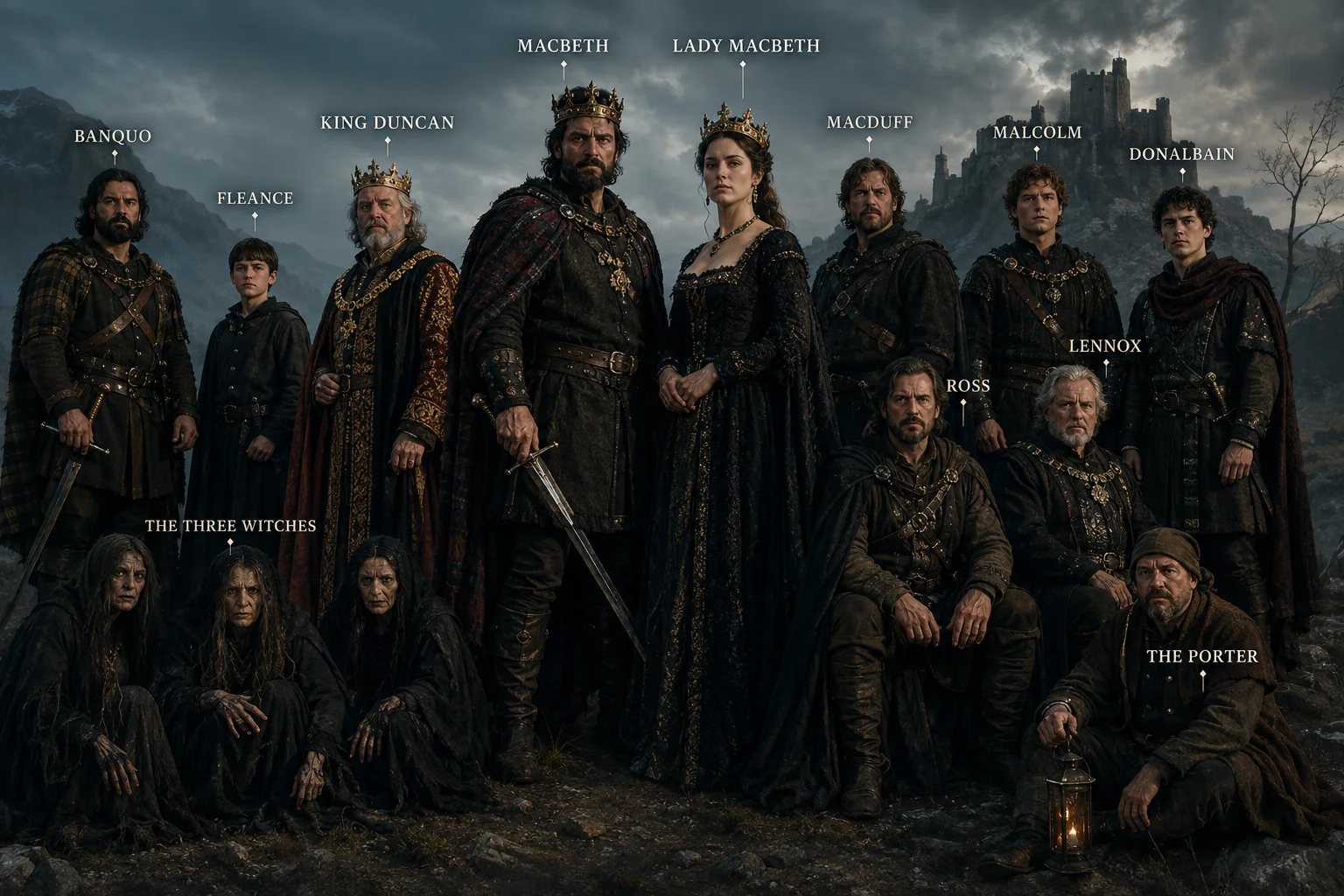
Major Characters Of Macbeth
Shakespeare’s Macbeth is driven by a group of complex and memorable characters, each playing a significant role in the development of the tragedy. Understanding their personalities, motivations, relationships, and contributions to the plot is essential for answering character-based, extract-based, and analytical questions in the ISC English Literature examination.
Macbeth
Macbeth is the tragic hero of the play and a brave Scottish general who earns King Duncan’s trust through his loyalty and courage. However, after hearing the witches’ prophecy, his growing ambition leads him to murder Duncan and seize the throne. As the play progresses, Macbeth transforms from an honourable soldier into a fearful and ruthless tyrant, making his rise and downfall the central focus of Shakespeare’s tragedy.
Lady Macbeth
Lady Macbeth is one of Shakespeare’s most powerful female characters. Highly ambitious and determined, she persuades Macbeth to murder King Duncan in order to fulfil the witches’ prophecy. Although she initially appears fearless and practical, overwhelming guilt gradually destroys her mental peace, leading to her famous sleepwalking scene and tragic death.
Banquo
Banquo is Macbeth’s close friend, a brave nobleman, and a fellow recipient of the witches’ prophecy. Unlike Macbeth, he refuses to act dishonourably to fulfil his destiny, making him a symbol of integrity and moral strength. His murder and later appearance as a ghost reflect Macbeth’s growing guilt and psychological instability.
King Duncan
King Duncan is the noble and rightful King of Scotland, admired for his wisdom, generosity, and fairness. His trust in Macbeth ultimately leads to his assassination, an event that marks the turning point of the play. Duncan represents ideal kingship and serves as a contrast to Macbeth’s cruel and tyrannical rule.
Macduff
Macduff is the Thane of Fife and one of the play’s most honourable characters. Deeply loyal to Scotland, he opposes Macbeth’s tyranny and becomes the instrument of justice by defeating him in the final battle. The murder of his family strengthens his determination to restore peace and rightful leadership to Scotland.
Malcolm
Malcolm is King Duncan’s eldest son and the rightful heir to the Scottish throne. After escaping to England following his father’s murder, he patiently gathers support to reclaim his kingdom. His wisdom, caution, and sense of justice make him the ideal ruler who restores order at the end of the play.
The Three Witches
The Three Witches introduce the element of the supernatural and set the tragedy in motion through their mysterious prophecies. Their predictions awaken Macbeth’s ambition and influence many of his decisions, while also raising important questions about fate, free will, and the power of temptation.
Ross
Ross is a Scottish nobleman who acts as a trusted messenger throughout the play. He carries important news between characters and witnesses many of the political changes occurring in Scotland. His role helps advance the plot while reflecting the changing fortunes of Macbeth’s reign.
Lennox
Lennox is another Scottish nobleman who gradually recognises Macbeth’s tyranny. As the story progresses, he becomes increasingly suspicious of Macbeth’s actions and eventually supports Malcolm’s efforts to restore lawful rule in Scotland.
The Porter
Although the Porter appears only briefly, his famous comic scene provides temporary relief after King Duncan’s murder. His humorous speech about the “porter of hell-gate” also symbolically suggests that Macbeth’s castle has become a place of evil and moral corruption.
While preparing character-based questions, don’t focus only on physical descriptions or major incidents. Pay attention to each character’s personality, motivations, relationships, strengths, weaknesses, important speeches, and contribution to the themes of the play, as these aspects are frequently tested in ISC English Literature examinations.
Major Themes of Macbeth
Shakespeare’s Macbeth explores several timeless themes that shape the story and the decisions of its characters. Understanding these ideas helps students appreciate the deeper meaning of the play and write stronger analytical answers in ISC English Literature examinations.
Ambition
Ambition is the driving force behind Macbeth’s rise and downfall. Shakespeare shows how the desire for power, when not guided by morality, can lead to betrayal, violence, and self-destruction.
Guilt and Conscience
After Duncan’s murder, both Macbeth and Lady Macbeth suffer from intense guilt. Their psychological struggles demonstrate that wrongdoing brings lasting emotional consequences.
Fate vs Free Will
The witches’ prophecies raise questions about destiny and personal choice. While fate presents possibilities, Shakespeare suggests that Macbeth’s own decisions ultimately shape his future.
Appearance vs Reality
The play repeatedly shows that people and situations are not always what they seem. Characters hide their true intentions, making deception a recurring element throughout the tragedy.
The Supernatural
The Three Witches, apparitions, and ghostly visions create an atmosphere of mystery while influencing Macbeth’s thoughts and actions. They highlight the conflict between temptation and personal responsibility.
Power and Kingship
Through Duncan, Macbeth, and Malcolm, Shakespeare contrasts just leadership with tyranny, emphasising that true power should be exercised with wisdom, justice, and responsibility.
Violence and Revenge
Violence becomes a cycle in the play as one murder leads to another. Shakespeare illustrates that power gained through bloodshed ultimately results in fear, resistance, and destruction.
Loyalty and Betrayal
The play explores the conflict between loyalty and personal ambition. While characters like Banquo and Macduff remain honourable, Macbeth betrays his king, friends, and moral values.
Masculinity and Courage
Shakespeare questions traditional ideas of masculinity through Macbeth and Lady Macbeth. The play suggests that true courage lies in integrity and moral strength rather than acts of violence.
Justice and Moral Order
Despite the chaos caused by Macbeth’s actions, justice is restored by the end of the play. Shakespeare reinforces the idea that evil may triumph temporarily, but righteousness ultimately prevails.
Literary Devices in Macbeth
Shakespeare uses a wide range of literary and dramatic devices in Macbeth to develop characters, build suspense, and convey the central themes of the play. Recognising these techniques helps students appreciate Shakespeare’s writing style and answer literary appreciation questions more effectively in the ISC English Literature examination.
Dramatic Irony
The audience often knows more than the characters, creating suspense and emotional impact. For example, the audience is aware of Macbeth’s plans long before King Duncan discovers the truth.
Soliloquy
Macbeth’s soliloquies reveal his inner thoughts, fears, ambitions, and guilt. They allow the audience to understand his psychological conflict and gradual moral decline.
Symbolism
Shakespeare uses symbols such as blood, sleep, darkness, and the crown to represent guilt, innocence, evil, and power throughout the play.
Foreshadowing
The witches’ prophecies, supernatural events, and unusual omens hint at future events, creating suspense and preparing the audience for the unfolding tragedy.
Imagery
The play contains vivid imagery related to blood, violence, darkness, nature, and the supernatural, making the emotions and atmosphere more powerful and memorable.
Motif
Recurring elements such as blood, sleeplessness, unnatural weather, and visions reinforce important themes like guilt, ambition, and the disruption of the natural order.
Paradox
Statements such as “Fair is foul, and foul is fair” express contradictory ideas that reflect the confusion between appearance and reality throughout the play.
Personification
Shakespeare frequently gives human qualities to nature, darkness, and other abstract ideas to create dramatic effect and strengthen emotional expression.
Allusion
The play contains references to mythology, religion, and historical beliefs, enriching the meaning of important speeches and enhancing the play’s cultural depth.
Comic Relief
The Porter’s scene immediately after Duncan’s murder provides a brief moment of humour, reducing tension while also highlighting the horror of the crime that has just taken place.
Smart Revision Strategy for Macbeth
Preparing Macbeth becomes much easier when you revise the play systematically instead of memorising answers at the last moment. A structured approach not only improves your understanding of Shakespeare’s language but also helps you write more analytical and well-supported answers in the ISC English Literature examination.
Follow this simple revision plan:
Read each Act and understand the sequence of important events.
Revise the dramatic context before attempting extract-based questions.
Learn the major characters along with their motivations and development.
Understand the central themes and connect them with important scenes.
Memorise key quotations and identify their speaker, context, and significance.
Revise important soliloquies and speeches from each Act.
Identify literary devices such as symbolism, dramatic irony, imagery, and foreshadowing.
Practise workbook questions before comparing them with the provided solutions.
Revise summaries of each Scene for quick recall before examinations.
Attempt previous examination-style questions to improve answer-writing and time management.
Focus on understanding why events happen in the play rather than memorising prepared answers. Students who explain the dramatic context, support their points with relevant quotations, and analyse Shakespeare’s techniques usually perform better in ISC English Literature examinations.
Exam Preparation Tips
Scoring well in Macbeth requires more than memorising workbook answers. The ISC English Literature examination rewards students who understand the dramatic context, analyse characters and themes, and support their answers with relevant textual references. Consistent revision and regular practice are the keys to building confidence.
Follow these tips while preparing:
Read every Act carefully before referring to the workbook solutions.
Understand the context of important extracts instead of memorising answers.
Revise major characters, themes, and literary devices regularly.
Learn important quotations along with their speaker and significance.
Pay special attention to Macbeth’s and Lady Macbeth’s soliloquies.
Practise answering extract-based and analytical questions within a time limit.
Support your answers with relevant incidents and quotations whenever possible.
Revise scene summaries before examinations for quick recall.
Attempt workbook exercises on your own before checking the solutions.
Maintain short notes for important speeches, symbols, and recurring themes.
The strongest answers are those that explain the dramatic context, analyse the characters’ actions, and include relevant textual evidence. Focus on understanding Shakespeare’s ideas rather than memorising fixed answers, and you’ll be better prepared for both school assessments and the ISC English Literature examination.
Explore Other Workbook Solutions
Browse chapter-wise ISC workbook solutions for Rhapsody & Prism and Total English for Classes 11 and 12.
ISC Macbeth Workbook Answers FAQs
Frequently Asked Questions
ISC Macbeth Workbook Answers FAQs
Find quick answers to the most common questions about our ISC Macbeth workbook answers, Morning Star and Evergreen workbook solutions, examination preparation, themes, character analysis, important quotations, literary devices, and more.
Yes. The workbook answers and explanations on this page are prepared according to the current ISC English Literature syllabus. The solutions follow the prescribed text and focus on scene-wise understanding, literary appreciation, character analysis, and examination-oriented preparation. If the syllabus or workbook edition changes in the future, the relevant sections of this page will be updated accordingly.
This resource is designed for students using both the Morning Star and Evergreen Macbeth workbooks prescribed for the ISC English Literature syllabus. The Act-wise workbook solutions are organised scene by scene, making it easy to locate specific exercises, explanations, and related study resources for effective examination preparation.
Yes. This page serves as a complete hub for Act-wise Macbeth workbook answers, covering all five Acts of the play. Each Act is organised scene by scene, making it easy to locate specific workbook exercises, extract-based questions, summaries, and explanations from one place.
Workbook answers provide a strong foundation, but students should also understand the dramatic context, character development, important quotations, themes, literary devices, symbolism, and Shakespeare's use of language. This page combines workbook solutions with additional study resources to help students develop a deeper understanding of the play.
Begin by reading the prescribed Scene from your textbook before attempting the workbook questions independently. After completing the exercise, compare your responses with the solutions provided here and review the explanations to understand the reasoning behind each answer. This method improves comprehension, analytical thinking, and answer-writing skills.
Yes. In addition to workbook solutions, this page includes scene summaries, important quotations, character analysis, major themes, literary devices, revision strategies, examination tips, and other study resources designed to help students understand Shakespeare's Macbeth more effectively.
Students should have a thorough understanding of Macbeth, Lady Macbeth, Banquo, Macduff, Malcolm, King Duncan, the Three Witches, Ross, Lennox, and the Porter. Understanding their motivations, relationships, and role in the development of the tragedy is essential for character-based and extract-based questions.
Macbeth's soliloquies reveal his inner thoughts, ambitions, fears, and guilt at different stages of the play. They help readers understand his psychological transformation from a loyal Scottish nobleman to a tragic ruler and are frequently discussed in literary appreciation and examination questions.
Some of the most significant themes include ambition, guilt, fate versus free will, appearance versus reality, the supernatural, kingship, loyalty, betrayal, violence, justice, and moral responsibility. These themes frequently appear in extract-based, analytical, and long-answer questions in the ISC English Literature examination.
Many examination questions require students to explain what happens before or after a particular extract. Understanding the dramatic context helps students interpret speeches correctly, analyse character motivations, and write well-supported answers instead of relying on memorised responses.
Absolutely. Teachers may use these explanations while discussing important scenes, themes, and literary devices in the classroom, while parents can refer to the solutions to guide students with homework, revision, and a better understanding of Shakespeare's language and dramatic techniques.
A balanced revision strategy includes reading scene summaries, revising important quotations, understanding character development, identifying major themes and literary devices, and practising extract-based questions. Regular revision using Act-wise workbook solutions helps students strengthen both conceptual understanding and examination confidence.
Unlike a traditional answer key that provides only direct solutions, this page has been designed as a comprehensive study resource. Along with workbook answers, students can explore scene summaries, character analysis, major themes, literary devices, important quotations, revision guidance, and examination tips. The objective is to help students understand Shakespeare's play in depth while improving their analytical and answer-writing skills for the ISC English Literature examination.