Date reflects latest content revision | Updated with Latest syllabus alignment
Table of Contents
Preparing Julius Caesar for ICSE English Literature can be challenging, especially when understanding Shakespeare’s language, dramatic techniques, and extract-based questions. To make your preparation easier, this page brings together complete workbook answers for Acts 1 to 5, along with scene-wise explanations, summaries, important questions, character analysis, themes, and revision resources—all organised in one place.
Whether your school follows the Morning Star or Evergreen workbook, you can quickly access the required Act, Scene, or exercise without searching through multiple pages. Every solution is written in simple, student-friendly language while maintaining the analytical style expected in ICSE examinations.
Along with accurate workbook answers, the explanations help you understand the context of each extract, the significance of important speeches, character motivations, literary devices, and the dramatic development of the play. The objective is not only to help you complete workbook exercises but also to strengthen your understanding of Shakespeare’s Julius Caesar for school tests, pre-board examinations, and the ICSE English Literature examination.
Every solution is written in clear, student-friendly language while maintaining the analytical approach expected in ICSE examinations. Along with accurate answers, the explanations highlight dramatic context, literary significance, important quotations, and character development so that you can confidently attempt school tests, pre-board examinations, and the ICSE English Literature paper.
Use this page as your complete study companion for Julius Caesar. Simply select the required Act or Scene to access detailed workbook solutions and strengthen your understanding of Shakespeare’s timeless political tragedy.
Complete Act-Wise Julius Caesar Solutions
This page includes detailed workbook answers and explanations for all major scenes in the play, including:
Act 1 workbook answers & solutions
Act 2 workbook answers & solutions
Act 3 workbook answers & solutions
Act 4 and Act 5 workbook answers & solutions
Summary
Multiple Choice Questions
Important extract-based questions
Character and theme analysis
All answers follow the latest ICSE English Literature syllabus and focus on clarity, accuracy, and proper answer-writing style.
Get The Official Workbook Home Delivered :
Buy Physical Book On Amazon
Buy Physical Book On Amazon
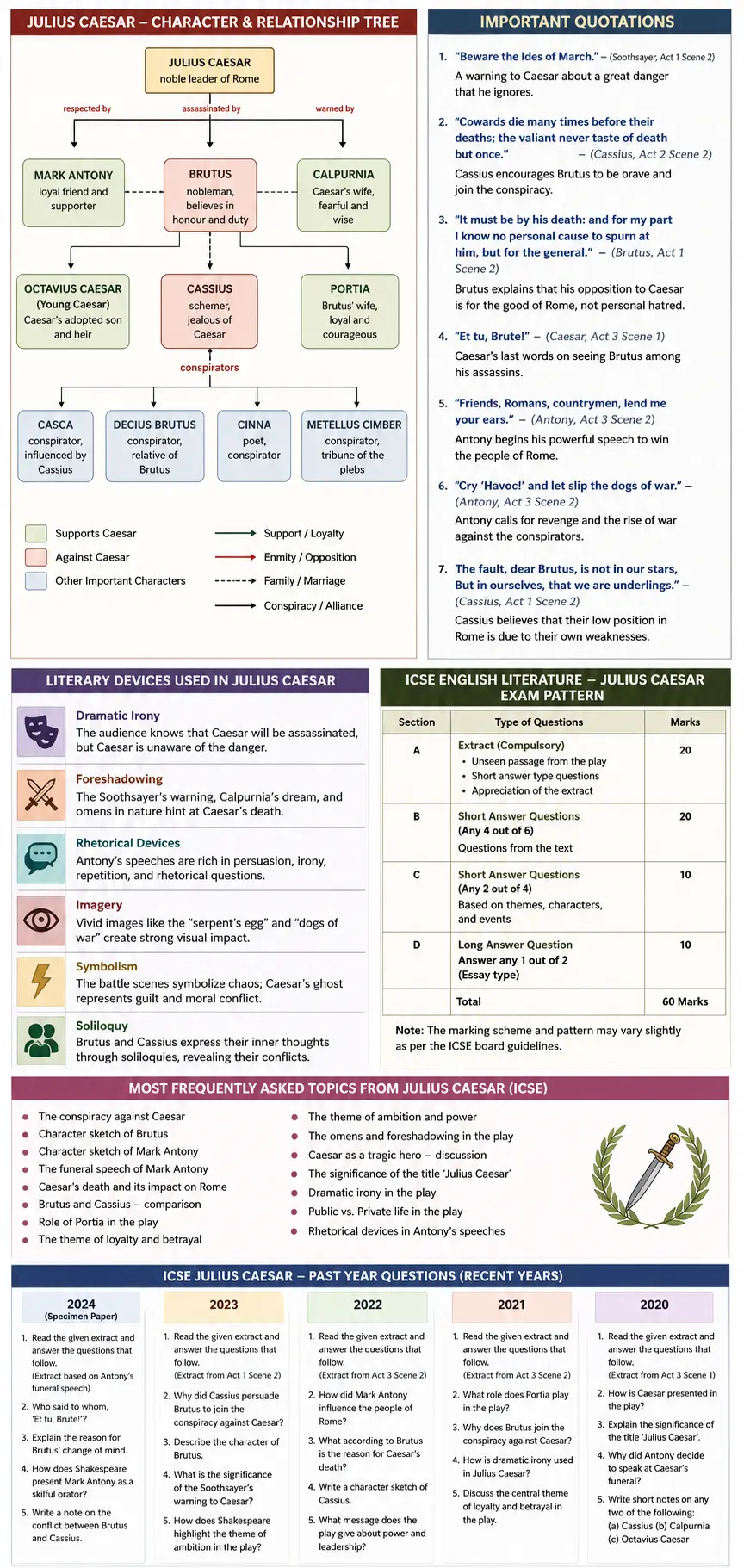
Important Quotations from Julius Caesar
The following quotations are among the most significant lines from Shakespeare’s Julius Caesar. Understanding their context, speaker, and dramatic significance will help students answer extract-based, character, and theme-related questions more effectively in ICSE examinations.
Quotation
Speaker
Significance
“Beware the Ides of March.”
Soothsayer
Foreshadows Caesar’s assassination and introduces the theme of fate.
“The fault, dear Brutus, is not in our stars, but in ourselves.”
Cassius
Highlights free will over destiny and motivates Brutus to act.
“It must be by his death.”
Brutus
Shows Brutus’ internal conflict and sense of duty towards Rome.
“Et tu, Brute?”
Julius Caesar
Symbolises the pain of betrayal by a trusted friend.
“Friends, Romans, countrymen, lend me your ears.”
Mark Antony
One of Shakespeare’s most famous openings, demonstrating Antony’s persuasive skill.
“Cry ‘Havoc!’ and let slip the dogs of war.”
Antony
Expresses Antony’s desire for revenge and foreshadows civil war.
“Cowards die many times before their deaths.”
Caesar
Reflects Caesar’s courage and confidence before his assassination.
“There is a tide in the affairs of men.”
Brutus
Encourages decisive action and illustrates the importance of opportunity.
“Yond Cassius has a lean and hungry look.”
Caesar
Demonstrates Caesar’s suspicion of Cassius’ ambition.
“This was the noblest Roman of them all.”
Antony
Antony’s final tribute to Brutus, recognising his honour despite political differences.
Revision Tip: Don’t memorise quotations in isolation. Always remember who said them, to whom, when, and why, as these details are frequently tested in extract-based questions.
This page has been designed as a complete study resource for ICSE Julius Caesar, bringing together everything a student needs to prepare the play effectively. Instead of searching across multiple pages for workbook answers, summaries, or explanations, you can use this hub to access all major learning resources in one organised place.
The Act-wise sections cover detailed workbook answers arranged according to the sequence of the play, making it easy to locate a particular Scene or exercise. Along with the solutions, you’ll also find scene summaries that explain the important events, extract-based questions commonly asked in school examinations, and multiple-choice questions for quick revision. To strengthen literary understanding, the page also includes discussions on major characters, recurring themes, dramatic techniques, and important quotations from the play.
Whether you’re completing homework, revising before a class test, or preparing for the ICSE English Literature examination, this page helps you move beyond memorising answers by encouraging a deeper understanding of Shakespeare’s writing. Every section is organised to make navigation simple so that students can quickly find the exact topic they need without unnecessary searching.
Why Julius Caesar Remains Relevant Today
Although Julius Caesar is set in Ancient Rome, its themes continue to resonate in modern society. Questions about leadership, political responsibility, loyalty, public opinion, ambition, and the ethical use of power remain relevant across different cultures and periods of history.
The play also demonstrates how persuasive communication can shape public opinion, how personal values influence political decisions, and how the consequences of individual actions can affect an entire nation. Studying these ideas not only improves literary appreciation but also encourages students to think critically about history, politics, and human behaviour.
Loved By 622.9k Students
ICSE English Literature Examination Pattern (Julius Caesar)
Julius Caesar forms an important part of the ICSE Class 10 English Literature paper. Although the exact question paper may change from year to year, students can generally expect questions that assess both textual understanding and literary appreciation.
The examination commonly includes:
Extract-Based Questions
Students are given a passage from the play and asked questions based on:
Context
Speaker and listener
Explanation of important lines
Character motives
Dramatic significance
Themes and literary devices
Character-Based Questions
Students may be asked to analyse characters such as:
Brutus
Cassius
Julius Caesar
Mark Antony
Portia
Calpurnia
Theme-Based Questions
Questions frequently focus on:
Honour
Betrayal
Ambition
Loyalty
Leadership
Fate vs Free Will
Appreciation Questions
Students may also explain:
Dramatic irony
Persuasive speeches
Symbolism
Shakespeare’s portrayal of political conflict
Character development
Exam Tip: ICSE values well-supported answers. Wherever appropriate, refer to important incidents or quotations from the play to strengthen your response.
Frequently Tested Areas in ICSE Examinations
While every examination paper is different, certain topics have appeared repeatedly over the years because they are central to Shakespeare’s play.
Students should revise the following areas thoroughly:
Brutus as the tragic hero
Character sketch of Mark Antony
Character sketch of Cassius
Julius Caesar’s strengths and weaknesses
Antony’s funeral speech
The conspiracy against Caesar
Caesar’s assassination
Calpurnia’s dream
The Soothsayer’s warning
Portia’s role in the play
Brutus’ internal conflict
Cassius’ manipulation of Brutus
The quarrel between Brutus and Cassius
Caesar’s Ghost
Battle of Philippi
Honour and patriotism
Ambition and power
Friendship and betrayal
Public duty versus personal loyalty
Fate versus free will
Persuasion and rhetoric
Dramatic irony
Important soliloquies and speeches
These topics frequently form the basis of extract questions, character analysis, and long-answer discussions.
Why These Workbook Answers Help ICSE Students
Studying Julius Caesar is often challenging because Shakespeare’s language, historical background, and dramatic structure can seem unfamiliar at first. Simply reading the answers is rarely enough to understand why a character speaks or acts in a particular way. For this reason, the workbook solutions on this page are designed to explain not only the correct responses but also the context behind important scenes and speeches.
Each answer is written in clear, student-friendly language while maintaining the analytical approach expected in ICSE examinations. Where necessary, the explanations highlight character motivations, literary devices, dramatic significance, and the connection between different events in the play. This helps students develop stronger interpretation skills instead of relying solely on memorisation.
The organised Act-wise structure also makes revision more efficient. Students can revisit specific Scenes, practise extract-based questions, review important speeches, and strengthen their understanding of recurring ideas before examinations. Teachers and parents may also find these explanations useful while discussing the play or guiding students through difficult passages.
Understanding Shakespeare’s Julius Caesar
Written by William Shakespeare, Julius Caesar is one of the most widely studied plays in English literature and remains an important part of the ICSE English Literature syllabus. Although inspired by historical events from Ancient Rome, the play explores ideas that continue to be relevant today, including political ambition, leadership, public responsibility, friendship, betrayal, and moral conflict.
Rather than presenting a simple struggle between heroes and villains, Shakespeare develops complex characters whose decisions are influenced by personal values, emotions, and political circumstances. Brutus, for example, believes he is acting for the good of Rome, while Cassius is driven by jealousy and political ambition. Antony’s famous funeral speech demonstrates the power of language and persuasion, while Caesar’s confidence highlights the dangers of pride and overconfidence.
Throughout the workbook solutions, students will encounter important dramatic techniques such as irony, symbolism, foreshadowing, rhetorical speeches, and character development. Understanding these literary elements not only improves appreciation of the play but also helps students answer analytical and extract-based questions more confidently during examinations.
Major Characters Of Julius Caesar
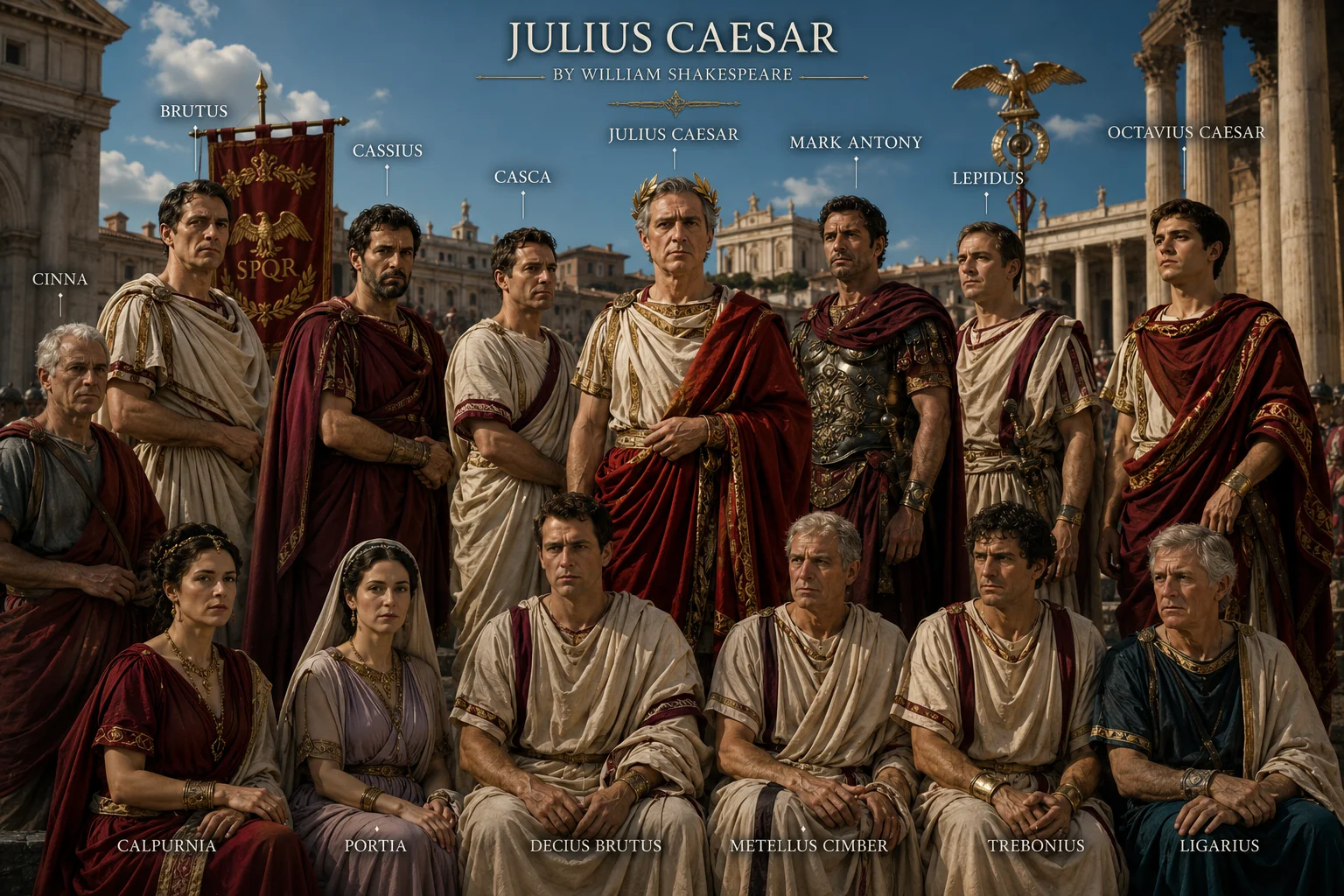
The strength of Julius Caesar lies in its memorable characters, each contributing to the political conflict and emotional depth of the play. Understanding their personalities, relationships, and motivations is essential for answering character-based questions in ICSE examinations.
Julius Caesar is presented as a respected Roman leader whose growing popularity raises fears about absolute power. Although he appears confident and courageous, his pride and disregard for repeated warnings ultimately lead to his assassination.
Brutus is one of the most admired yet tragic figures in the play. Guided by honour and patriotism, he joins the conspiracy believing that Caesar’s death will protect Rome, but his decisions result in personal loss and political chaos.
Cassius acts as the architect of the conspiracy. Intelligent, persuasive, and politically ambitious, he manipulates Brutus by appealing to his sense of duty and concern for the Republic.
Mark Antony initially appears loyal to Caesar but later emerges as a brilliant strategist and powerful orator. His funeral speech dramatically shifts public opinion and changes the course of the play.
Other important characters, including Portia, Calpurnia, Casca, Decius Brutus, and Octavius Caesar, further develop the themes of loyalty, leadership, persuasion, and sacrifice. Their actions and interactions help shape the tragedy while providing valuable material for examination questions.
Major Themes Of Julius Caesar
Shakespeare uses Julius Caesar to explore several important themes that remain relevant beyond the historical setting of Ancient Rome. These ideas appear repeatedly throughout the play and often form the basis of analytical and extract-based questions in ICSE examinations.
One of the central themes is ambition, as characters struggle with power, authority, and political influence. Closely connected to this is the conflict between public duty and personal loyalty, particularly through Brutus, who sacrifices his friendship with Caesar for what he believes is the greater good of Rome.
The play also examines betrayal, showing how trust can be broken by political interests and personal beliefs. Honour and integrity are explored through Brutus’ moral dilemmas, while persuasion and rhetoric are highlighted in Antony’s famous funeral speech, demonstrating how language can influence public opinion and shape history.
Other significant themes include leadership, fate and free will, justice, friendship, appearance versus reality, and the consequences of individual choices. As students work through the workbook answers, these themes become easier to recognise across different Scenes, helping them connect individual events to the broader message of the play and write more thoughtful examination answers.
Literary Devices Of Julius Caesar
Shakespeare uses a variety of literary and dramatic techniques to develop characters, build suspense, and communicate the central ideas of the play. Understanding these devices improves literary appreciation and helps students write stronger analytical answers.
Dramatic Irony
The audience often knows more than the characters. For example, Caesar dismisses the Soothsayer’s warning and Calpurnia’s dream, while the audience is already aware of the conspiracy.
Foreshadowing
Several warnings predict Caesar’s death, including the Soothsayer’s prophecy, Calpurnia’s disturbing dream, and unusual natural events reported before the assassination.
Soliloquy
Brutus’ famous soliloquy in Act II reveals his moral dilemma and explains why he decides to join the conspiracy despite loving Caesar.
Rhetoric
Mark Antony’s funeral speech is one of the finest examples of persuasive rhetoric in English literature. Through repetition, irony, emotional appeal, and rhetorical questions, Antony gradually turns the Roman citizens against the conspirators.
Symbolism
Many objects and events carry symbolic meaning. Caesar’s statue represents political authority, while his ghost symbolises guilt, justice, and the consequences of betrayal.
Imagery
Shakespeare frequently uses vivid imagery, especially when describing storms, blood, sacrifice, and war, to create emotional impact and reinforce the tragic atmosphere.
Foils
Cassius and Brutus serve as character foils. While Cassius is driven by personal ambition and jealousy, Brutus acts out of patriotism and honour, allowing Shakespeare to explore different motivations behind the conspiracy.
Smart Revision Strategy for Julius Caesar
Rather than memorising answers, focus on understanding how different parts of the play connect with one another.
A practical revision plan is to:
Read each Scene before referring to the workbook answers.
Understand the context of every important extract.
Learn at least two important quotations for each major character.
Revise one theme after completing each Act.
Practise identifying literary devices in important speeches.
Solve workbook questions before reading the provided answers.
Revise summaries before attempting full-length answers.
This method improves both comprehension and answer-writing skills, making revision more effective for school examinations as well as the ICSE board examination.
Exam Preparation Tips
Success in ICSE English Literature depends on understanding the play rather than memorising prepared answers. Begin by reading each Scene carefully to understand the sequence of events, the relationships between characters, and the dramatic purpose of important speeches. After attempting the workbook questions on your own, compare your responses with the provided solutions to identify areas that need improvement.
While revising, pay special attention to the context of important extracts, as many examination questions require students to explain what happens before and after a given passage. Learning key quotations, understanding character development, and recognising recurring themes will help you write stronger analytical answers. It is also useful to revise literary devices such as irony, foreshadowing, symbolism, and persuasive rhetoric, as these frequently contribute to the interpretation of important scenes.
Finally, practise writing answers in a clear and organised manner instead of relying on memorised paragraphs. Regular revision using the Act-wise workbook solutions, summaries, and character discussions available on this page will improve both confidence and examination performance.
Explore Other Workbook Solutions
Browse chapter-wise ICSE workbook solutions for Treasure Chest and Total English for Classes 9 and 10.
Frequently Asked Questions
Julius Caesar Workbook Answers FAQs
Find quick answers to the most common questions about our ICSE Julius Caesar workbook solutions, study resources, examination preparation, themes, character analysis and more.
Yes. The workbook answers and explanations on this page are prepared according to the current ICSE English Literature syllabus. The solutions focus on scene-wise understanding, extract-based questions, character analysis, and literary appreciation expected in school examinations and board exams. If the prescribed workbook or syllabus is revised in the future, the relevant sections of this page will also be updated accordingly.
This resource is designed for students using the Morning Star and Evergreen Julius Caesar workbooks. The Act-wise solutions are organised to help students quickly locate the required Scene or exercise while preparing for homework, class tests, or examinations.
Yes. This page serves as the central hub for Act-wise workbook answers covering Acts 1 to 5. Each Act is divided into individual Scenes, allowing students to access detailed workbook solutions, summaries, and related study material from one place.
Workbook answers are an excellent starting point, but students should also understand the dramatic context, important quotations, themes, literary devices, and character development. This page combines workbook solutions with additional study resources to encourage conceptual learning rather than simple memorisation.
Begin by reading the assigned Scene from the textbook before attempting the workbook questions independently. Afterwards, compare your responses with the solutions provided on this page and review the explanations to understand the reasoning behind each answer. This approach improves both comprehension and answer-writing skills.
Yes. The explanations are suitable for regular classroom assignments, school examinations, pre-board tests, and final ICSE English Literature examinations. Since the solutions focus on understanding the play rather than memorising fixed responses, they remain useful throughout the academic year.
Yes. Along with workbook answers, this resource also includes scene summaries, discussions of major characters, important themes, literary devices, examination guidance, frequently asked questions, and links to related Julius Caesar study materials to provide a more complete understanding of the play.
Many ICSE examination questions require students to explain what happens before or after an extract. Understanding the dramatic context helps students interpret speeches correctly, explain character motivations, and write more analytical answers instead of relying solely on memorised responses.
Students should develop a clear understanding of Julius Caesar, Brutus, Cassius, Mark Antony, Portia, Calpurnia, Casca, Decius Brutus, and Octavius Caesar. Their relationships, motivations, and contributions to the development of the tragedy frequently appear in extract-based, short-answer, and long-answer questions.
Some of the most significant themes include ambition, honour, betrayal, loyalty, leadership, political responsibility, persuasion, fate versus free will, friendship, and the conflict between personal values and public duty. These themes often form the basis of analytical questions in ICSE examinations.
Absolutely. Teachers may use the explanations while discussing Scenes in the classroom, and parents can refer to the solutions when helping students with homework, revision, or understanding Shakespeare's language and dramatic techniques.
Many students initially find Shakespeare's language challenging. However, studying the play scene by scene, understanding the context, and regularly revising important speeches and characters makes the text much easier to follow. Using workbook answers together with summaries and literary explanations helps build confidence over time.
Unlike a traditional answer key that only provides solutions, this page is designed as a complete study resource. In addition to workbook answers, students can explore scene summaries, character analysis, important quotations, literary devices, major themes, revision guidance, and other supporting materials that help build a deeper understanding of Shakespeare's play and improve examination performance.



Hello Students ! You Can Ask Your Doubts Below