Date reflects latest content revision | Updated with Latest syllabus alignment
Table of Contents
Preparing for the ICSE Class 10 English Literature examination requires more than simply memorising workbook answers. A clear understanding of every poem, short story, literary device, theme, and the author’s message is essential for writing thoughtful and well-structured answers. This page has been created as a complete study resource for Treasure Chest Class 10, bringing together chapter-wise workbook solutions, summaries, literary analysis, revision material, and examination guidance in one organised place.
The Treasure Chest textbook, published by Morning Star Publications, introduces students to a carefully selected collection of poems and short stories by renowned writers from around the world. Each literary work explores unique ideas, emotions, and human experiences while helping students develop reading comprehension, literary appreciation, critical thinking, and analytical writing skills. Understanding these texts not only improves examination performance but also builds a deeper appreciation for English literature.
Rather than providing only direct workbook answers, this page explains the context, central ideas, important themes, literary devices, figures of speech, and significant details that help students understand every chapter with confidence. Whether you are studying Haunted Houses, The Pedestrian, The Last Lesson, or any other prescribed text, the explanations are designed to simplify complex concepts without compromising literary depth.
This resource is equally useful for students, teachers, and parents. The chapter-wise structure allows you to quickly locate the required poem or short story, making homework, classroom preparation, and last-minute revision more organised and efficient. Along with accurate workbook solutions, you’ll also find revision strategies, examination tips, author information, and other study resources that support a complete understanding of the prescribed syllabus.
Use this page as your comprehensive Treasure Chest Class 10 study companion throughout the academic year. Simply choose the chapter you wish to study and explore detailed workbook answers, summaries, important themes, literary devices, and examination-focused guidance—all carefully prepared to help you understand English Literature more effectively and perform with confidence in the ICSE examination.
Get The Official Workbook Home Delivered :
Buy Physical Book On Amazon
What’s included on this page
This page has been designed as a complete study hub for ICSE Treasure Chest Class 10, bringing together all the essential resources required to understand the prescribed poems and short stories with confidence. Instead of searching multiple websites for workbook answers, summaries, or revision notes, you can find everything organised in one place for quick and systematic learning.
Here, you’ll find chapter-wise workbook answers for every poem and short story prescribed in the latest ICSE English Literature syllabus. The solutions include extract-based questions, multiple-choice questions (MCQs), short-answer questions, and detailed explanations prepared in a clear, examination-oriented style. Each chapter is arranged separately, making it easy to navigate directly to the topic you wish to study or revise.
In addition to workbook solutions, this page also provides chapter summaries, central ideas, important themes, literary devices, figures of speech, author introductions, revision strategies, examination tips, and other learning resources that help students develop a deeper understanding of English Literature. Whether you’re preparing for a class test, pre-board examination, or the ICSE board examination, these resources are designed to strengthen both your conceptual understanding and answer-writing skills.
Simply select the required poem or short story below and explore a carefully organised collection of workbook solutions and study materials prepared to make learning English Literature simpler, more meaningful, and more enjoyable.
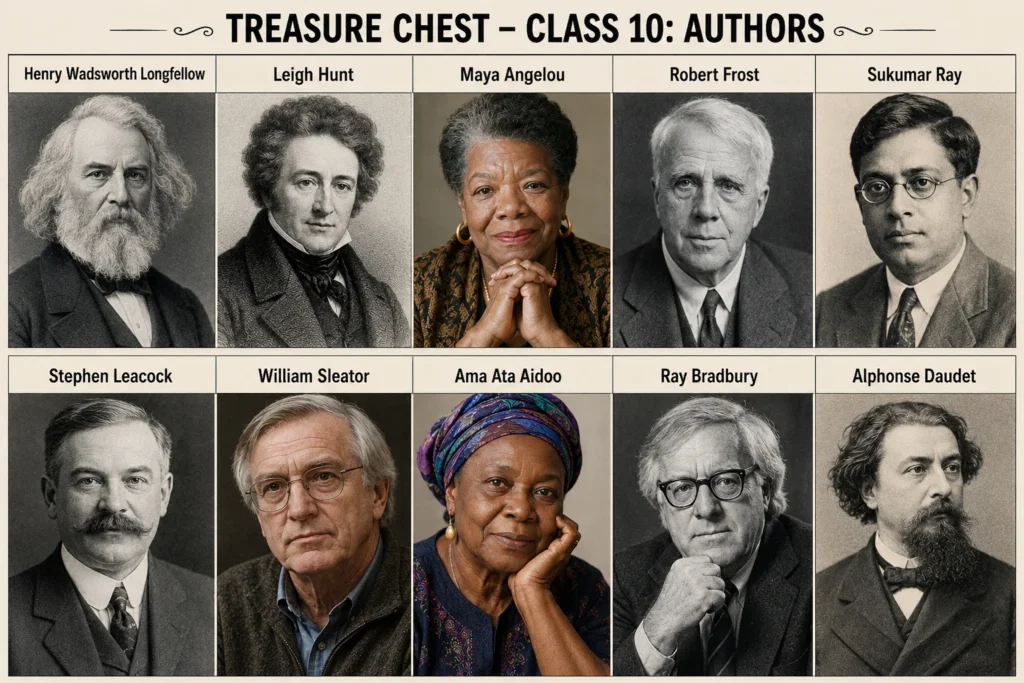
Meet the Authors – Treasure Chest (ICSE Class 10)
The Treasure Chest Class 10 anthology brings together the works of distinguished poets and authors from different literary traditions and cultures. Through their poems and short stories, students explore a wide range of themes, emotions, writing styles, and human experiences, making the study of English Literature both meaningful and enjoyable.
Chapter
Author
About the Author
Haunted Houses
Henry Wadsworth Longfellow
A renowned American poet celebrated for his lyrical poetry, historical themes, and inspiring works on life, faith, and human emotions.
The Glove and the Lions
Leigh Hunt
An English poet, essayist, and journalist known for his romantic poetry, wit, and engaging narrative style.
When Great Trees Fall
Maya Angelou
An internationally acclaimed American poet, memoirist, and civil rights activist whose writings celebrate resilience, hope, and human dignity.
A Considerable Speck
Robert Frost
One of America’s greatest poets, admired for his simple language, profound observations, and thought-provoking reflections on nature and life.
The Power of Music
Sukumar Ray
A celebrated Bengali writer, poet, and humourist best known for his imaginative storytelling, wit, and timeless works of nonsense literature.
With the Photographer
Stephen Leacock
A Canadian writer and humourist famous for his satirical stories that blend everyday situations with clever wit and comedy.
The Elevator
William Sleator
An American author recognised for his suspenseful young adult fiction, often exploring fear, psychology, and science fiction.
The Girl Who Can
Ama Ata Aidoo
An acclaimed Ghanaian author, playwright, and educator whose works explore African culture, identity, women’s empowerment, and social change.
The Pedestrian
Ray Bradbury
A celebrated American science-fiction writer known for exploring technology, imagination, individuality, and the future of society.
The Last Lesson
Alphonse Daudet
A distinguished French novelist and short story writer remembered for his realistic stories on patriotism, education, and everyday life.
Explore Other Workbook Solutions
Browse chapter-wise ICSE workbook solutions for Julius Caesar, Treasure Chest and Total English for Classes 9 and 10.
Why These Treasure Chest Solutions Help ICSE Students
Understanding English Literature involves much more than finding the correct answers to workbook questions. Every poem and short story in Treasure Chest explores different themes, emotions, literary techniques, and writing styles that require careful reading and interpretation. These workbook solutions are designed to simplify complex ideas while helping students understand the meaning, context, and significance of every chapter in an easy-to-follow manner.
Rather than encouraging rote learning, the solutions focus on building a strong conceptual understanding of the text. Along with accurate workbook answers, students can explore chapter summaries, important themes, literary devices, figures of speech, character analysis, and examination-oriented explanations that strengthen both comprehension and answer-writing skills. This approach helps students appreciate literature while preparing confidently for classroom discussions and examinations.
Whether you’re completing homework, revising before a class test, or preparing for the ICSE English Literature examination, these chapter-wise solutions provide a structured and reliable study resource. Teachers and parents can also use the explanations to guide students through difficult chapters, making learning more engaging, organised, and effective throughout the academic year.
About ICSE Treasure Chest ( Class 10 )
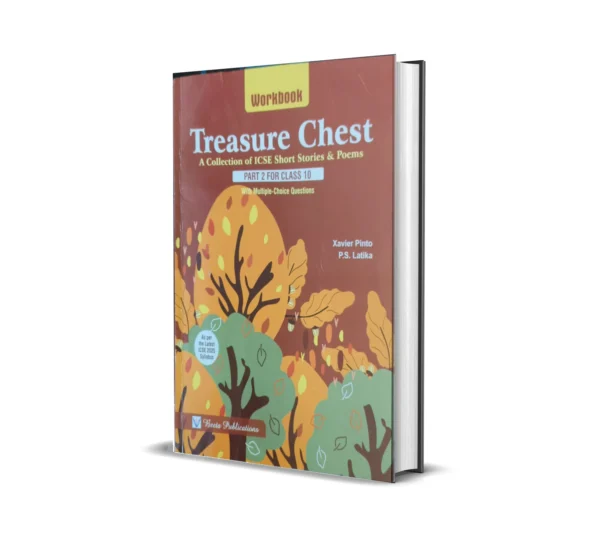
Treasure Chest is one of the prescribed English Literature textbooks for ICSE Class 10, published by Morning Star Publications. Prepared in accordance with the CISCE curriculum, the book contains a carefully selected collection of poems and short stories by renowned authors and poets from around the world. These literary works encourage students to develop language proficiency, literary appreciation, critical thinking, and analytical writing skills while preparing for the ICSE English Literature examination.
The anthology is divided into two sections—Poetry and Short Stories. The poems expose students to different poetic styles, emotions, imagery, symbolism, and figures of speech, while the short stories present engaging narratives that explore human relationships, courage, sacrifice, identity, technology, patriotism, and social values. Together, these chapters help students appreciate different forms of literature and understand how writers express ideas through language and storytelling.
Studying Treasure Chest involves much more than answering workbook questions. Every chapter encourages students to explore important literary concepts such as themes, characterisation, symbolism, imagery, tone, mood, irony, and narrative techniques. Developing a clear understanding of these elements helps students interpret texts more confidently, appreciate the author’s purpose, and write well-structured analytical answers in examinations.
Whether you are preparing for regular class assessments, pre-board examinations, or the ICSE board examination, Treasure Chest serves as an excellent foundation for English Literature. By understanding each chapter’s central idea, important themes, literary devices, and author’s message, students not only perform better in examinations but also develop a lasting appreciation for literature and effective communication skills.
₹ 199.00–₹ 399.00Price range: ₹ 199.00 through ₹ 399.00
Select options
This product has multiple variants. The options may be chosen on the product page
Complete Poetries Covered
The Poetry section of Treasure Chest Class 10 introduces students to a diverse collection of poems that explore themes such as life, courage, grief, individuality, imagination, and the transformative power of art. Each poem presents a unique perspective through rich imagery, symbolism, and poetic expression, helping students develop literary appreciation and critical thinking. Along with chapter-wise workbook answers, this page also provides summaries, central ideas, important themes, literary devices, figures of speech, and examination-oriented explanations for every prescribed poem.
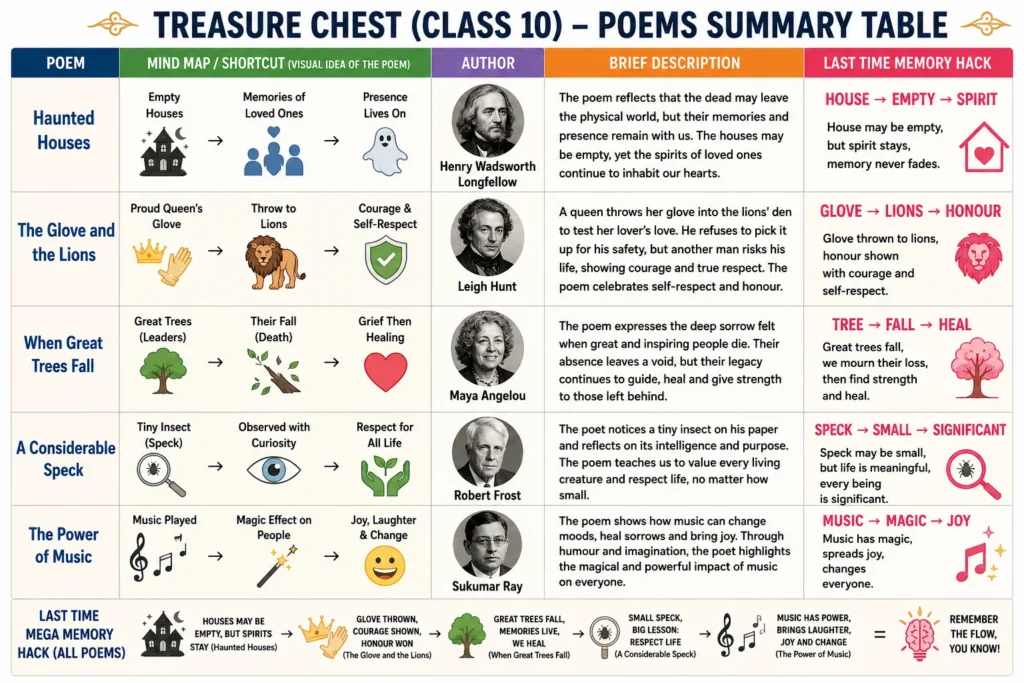
Haunted Houses – Henry Wadsworth Longfellow
Haunted Houses presents the idea that the memories and presence of those who have passed away continue to remain with us in spirit. Through beautiful imagery and a reflective tone, Longfellow explores themes of life, death, memory, and the unseen connection between the past and the present, encouraging readers to look beyond the physical world.
The Glove and the Lions – Leigh Hunt
Set in a royal court, this narrative poem tells the story of a courageous woman who teaches an important lesson about self-respect and true love. Through drama, suspense, and irony, Leigh Hunt highlights themes of courage, dignity, honour, and the importance of respecting oneself in every relationship.
When Great Trees Fall – Maya Angelou
This moving poem reflects on the grief experienced after the loss of extraordinary individuals whose lives inspire others. Maya Angelou beautifully portrays how sorrow gradually gives way to healing, hope, and renewed strength, celebrating the lasting influence of remarkable people.
A Considerable Speck – Robert Frost
In this thoughtful and humorous poem, Robert Frost observes a tiny insect crawling across a sheet of paper while he writes. The incident becomes an opportunity to reflect on individuality, intelligence, and the value of every living creature, demonstrating how even the smallest forms of life deserve attention and respect.
The Power of Music – Sukumar Ray
The Power of Music is a humorous narrative poem that illustrates how music has the remarkable ability to influence people’s emotions and behaviour. Through wit, exaggeration, and entertaining situations, Sukumar Ray celebrates the universal appeal of music while reminding readers of its joyful and transformative power.
Study Tip: While revising each poem, focus on its central idea, themes, important literary devices, figures of speech, tone, imagery, and the poet’s message. Understanding these aspects will help you confidently answer extract-based and analytical questions in the ICSE English Literature examination.
Complete Stories Covered
The Short Stories section of Treasure Chest Class 10 introduces students to a diverse collection of thought-provoking narratives that explore human emotions, courage, technology, identity, patriotism, and social values. Each story presents memorable characters and meaningful life lessons while exposing students to different styles of storytelling. Along with chapter-wise workbook answers, this page also provides summaries, character analysis, important themes, literary devices, and examination-oriented explanations to help students understand every story thoroughly.
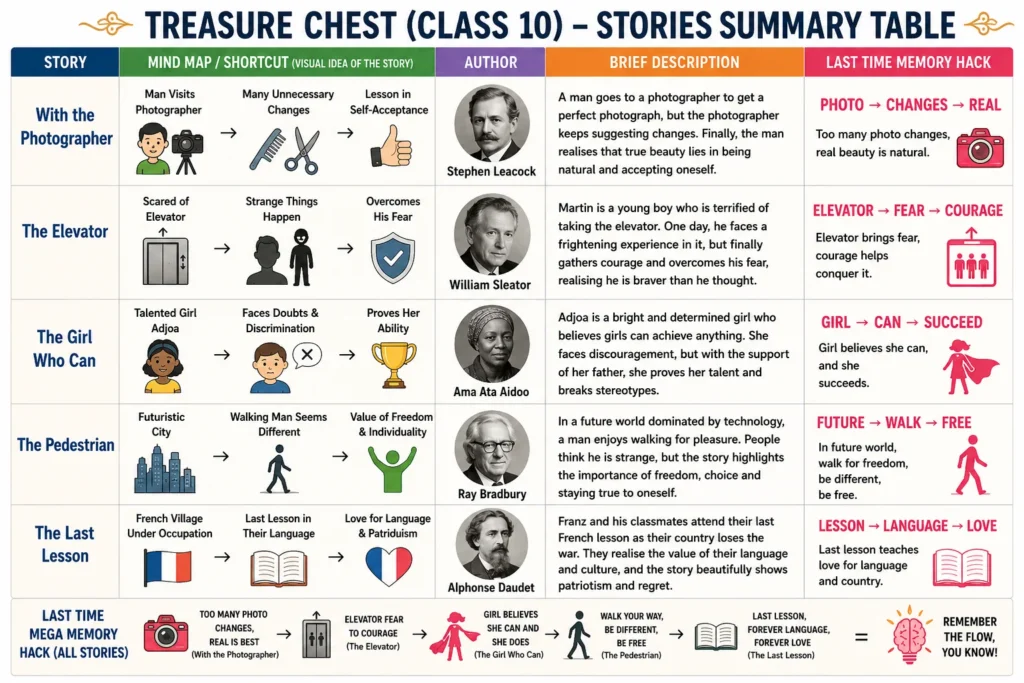
With the Photographer – Stephen Leacock
This humorous short story follows a man’s amusing experience at a photography studio, where an overconfident photographer insists on altering every aspect of his appearance. Through satire and witty dialogue, Stephen Leacock highlights themes of vanity, perfection, individuality, and the importance of accepting one’s natural self.
The Elevator – William Sleator
The Elevator is a gripping psychological story that centres on Martin, a young boy who struggles with fear and anxiety, particularly when using the elevator in his apartment building. Through suspense and mystery, the story explores themes of fear, courage, insecurity, and the human mind.
The Girl Who Can – Ama Ata Aidoo
This inspiring story portrays Adjoa, a young girl who challenges traditional beliefs about the role of women in society. Through her determination and self-confidence, the story explores themes of gender equality, identity, family support, and the importance of believing in one’s abilities.
The Pedestrian – Ray Bradbury
Set in a futuristic society dominated by technology, The Pedestrian follows Leonard Mead, a man whose simple habit of walking outdoors makes him appear unusual. Ray Bradbury uses this dystopian story to examine themes of individuality, freedom, technology, isolation, and the consequences of excessive dependence on machines.
The Last Lesson – Alphonse Daudet
Set during the Franco-Prussian War, The Last Lesson tells the emotional story of a French school where students attend their final lesson in their native language. Through the experiences of Franz and M. Hamel, the story highlights the importance of education, patriotism, cultural identity, and respect for one’s language and heritage.
Study Tip: While preparing the short stories, focus on the plot, character development, central themes, important incidents, literary devices, and the author’s message. Understanding these elements will help you confidently answer character-based, extract-based, and analytical questions in the ICSE English Literature examination.
Fear, Anxiety, Courage, Psychological Conflict, Growing Up
The Girl Who Can
Gender Equality, Self-Confidence, Determination, Family Support, Identity
The Pedestrian
Technology, Individuality, Freedom, Isolation, Human Connection
The Last Lesson
Patriotism, Education, Love for Language, National Identity, Regret
Revision Tip: While revising each chapter, connect the themes with important incidents, characters, literary devices, and quotations instead of studying them separately. This approach will help you interpret the text more effectively and write well-supported answers in the ICSE English Literature examination.
ICSE Board-Level Important Questions
Important Questions From Poems
1. “A Work of Artifice” uses the bonsai tree as a powerful symbol. Explain how this symbol conveys the poet’s message about human potential and freedom.
2. How does Marge Piercy criticise social conditioning in A Work of Artifice? Support your answer with suitable references from the poem.
3. In “I Remember, I Remember,” how does Thomas Hood contrast the joys of childhood with the realities of adulthood?
4. Describe the emotions expressed by the doctor in “A Doctor’s Journal Entry for August 6, 1945.” How does the poem promote the message of peace?
5. Why is Skimbleshanks admired by everyone on the night mail train? Discuss the qualities that make him an ideal railway cat.
6. How does W. H. Auden use rhythm and sound in “The Night Mail” to create the impression of a moving train?
7. Compare the central ideas of any two prescribed poems from Treasure Chest Class 9. How are their messages different?
8. Choose any one prescribed poem and explain how imagery and symbolism help the poet communicate the central idea.
Important Questions From Short Stories
9. How does The Boy Who Broke the Bank show the dangers of rumours and misunderstandings? Explain with suitable incidents from the story.
10. Describe the character of Bonku Babu before and after meeting Ang. What changes do you observe in his personality?
11. Why is Oliver’s request for “more” considered a turning point in Oliver Asks for More? What does it reveal about Victorian society?
12. How does Oscar Wilde prove that kindness is more valuable than wealth in The Model Millionaire?
13. Discuss the character of Phatik in Home-Coming. How does Rabindranath Tagore make the reader sympathise with him?
14. Choose any one short story and explain how the author uses humour, irony, or satire to convey a deeper message.
15. Which short story from Treasure Chest Class 9 impressed you the most? Give reasons with suitable references to the text.
How to Study Treasure Chest Effectively
Studying Treasure Chest becomes much easier when you focus on understanding each chapter instead of memorising workbook answers. Every poem and short story has its own message, themes, literary techniques, and writing style, so a step-by-step approach helps you build a stronger foundation in English Literature while improving your analytical and answer-writing skills.
Follow this simple study strategy:
Read the complete poem or short story before referring to the workbook answers.
Understand the central idea, important events, and the author’s message.
Revise the summary to strengthen your overall understanding of the chapter.
Learn the major themes, literary devices, and figures of speech used in the text.
Practise workbook questions on your own before checking the provided solutions.
Memorise important quotations and understand their context wherever applicable.
Revise difficult chapters regularly instead of leaving everything for the last week.
Make short notes of important characters, themes, and literary terms for quick revision.
Solve extract-based questions to improve interpretation and analytical writing skills.
Before examinations, revise chapter summaries, important themes, literary devices, and workbook answers together for complete preparation.
Why Treasure Chest is Important for ICSE Students
Each chapter provides opportunities to explore important literary elements such as themes, characterisation, symbolism, imagery, tone, and figures of speech. By understanding these concepts, students learn how to interpret literature critically and express their ideas in a clear, well-supported manner. These skills are valuable not only for scoring well in English Literature but also for improving overall language proficiency.
The workbook exercises further strengthen learning by encouraging students to analyse extracts, interpret the author’s message, and practise examination-style questions. Whether you’re preparing for classroom discussions, school examinations, or the ICSE board examination, Treasure Chest lays a strong foundation for literary understanding and confident answer writing. Studying each poem and short story with the right approach helps students appreciate literature while developing the analytical skills expected in higher classes.
Exam Preparation Tips
Scoring well in ICSE English Literature requires more than memorising workbook answers. The examination tests your understanding of the text, ability to interpret literary ideas, and skill in presenting well-structured answers. A consistent study routine and regular revision of important concepts will help you approach every chapter with confidence.
Follow these tips while preparing:
Read every poem and short story carefully before attempting the workbook exercises.
Understand the central idea, themes, and the author’s message instead of memorising answers.
Revise chapter summaries to strengthen your understanding of the text.
Learn important literary devices and figures of speech with suitable examples.
Practise extract-based questions and focus on explaining the context accurately.
Revise important quotations, characters, and key incidents from every chapter.
Solve workbook questions independently before referring to the provided solutions.
Make short notes of difficult chapters for quick revision before examinations.
Manage your time by practising answers within the examination time limit.
Revise regularly instead of leaving the entire syllabus for the last few days.
Exam Preparation Tip: The best answers are those that combine a clear understanding of the chapter with relevant textual references and logical explanations. Instead of memorising lengthy answers, focus on understanding the author’s message, literary techniques, and the significance of important events. This approach will help you perform confidently in school examinations as well as the ICSE English Literature board examination.
ICSE Examination Pattern For Treasure Chest
The Treasure Chest anthology forms an important part of the ICSE English Literature syllabus for Class 10. Through its collection of poems and short stories, students are assessed not only on their knowledge of the text but also on their ability to interpret literary ideas, analyse characters and themes, and appreciate the author’s style. The emphasis is on understanding the text rather than memorising answers.
During school examinations, students can generally expect extract-based questions, short-answer questions, theme and character-based questions, and literary appreciation questions from the prescribed poems and short stories. These questions assess a student’s understanding of the context, central idea, literary devices, figures of speech, and the author’s message. Regular practice of workbook exercises and careful revision of every chapter help build confidence for both school assessments and future board examinations.
Important Areas Commonly Assessed
Extract-based Questions – Context, explanation of important lines, interpretation, and the significance of the given passage.
Short-answer Questions – Plot, central idea, important incidents, and factual understanding.
Theme-based Questions – Questions based on the central message, moral values, and underlying ideas of each poem or story.
Character-based Questions – Character traits, relationships, motivations, and contribution to the story.
Literary Appreciation – Literary devices, figures of speech, imagery, symbolism, tone, mood, and the author’s writing style.
Vocabulary and Interpretation – Understanding difficult words, phrases, poetic expressions, and contextual meanings.
Frequently Asked Topics By ICSE
While the exact examination questions vary from year to year, certain concepts and question types are consistently tested from the Treasure Chest anthology. Preparing these areas thoroughly will strengthen your understanding of the prescribed poems and short stories while improving your performance in extract-based, short-answer, and analytical questions.
Chapter
Frequently Tested Areas
Haunted Houses
Meaning of ghosts, symbolism of haunted houses, imagery, bridge of light, theme of life after death
The Glove and the Lions
Character of Count de Lorge, vanity vs true love, irony, King’s judgement
When Great Trees Fall
Extended metaphor, effect of loss, imagery, hope after grief
A Considerable Speck
Symbolism of the speck, individuality, Frost’s philosophy, irony
The Power of Music
Humour, power of music, exaggeration, central message
With the Photographer
Satire, characterization of photographer, humour, self-acceptance
Character of Adjoa, gender stereotypes, Nana’s role, self-confidence
The Pedestrian
Technology vs humanity, Leonard Mead, dystopian society, symbolism
The Last Lesson
Patriotism, M. Hamel, love for language, irony, Franz’s transformation
Revision Tip: Instead of trying to predict examination questions, prepare every chapter thoroughly. A clear understanding of the summary, themes, literary devices, important quotations, and the author’s message will help you confidently answer almost any question asked in the ICSE English Literature examination.
Smart Revision Strategy For Treasure Chest
Follow this simple revision plan:
Read one poem or short story at a time instead of studying multiple chapters together.
Revise the summary before moving on to workbook questions.
Understand the central idea, themes, and author’s message of every chapter.
Learn important literary devices and figures of speech with suitable examples.
Revise important quotations and understand their context and significance.
Practise extract-based questions and explain the context in your own words.
Solve workbook exercises independently before checking the provided solutions.
Prepare short notes for important themes, characters, literary devices, and difficult vocabulary.
Revise completed chapters regularly to improve long-term retention.
Before examinations, go through summaries, important themes, literary devices, quotations, and workbook answers for quick revision.
Pro Tip: Don’t try to memorise lengthy answers. If you understand the summary, central idea, important themes, literary devices, and the author’s message, you’ll be able to write confident, well-structured answers even when the questions are framed differently in the examination.
FAQ
Frequently Asked Questions
Treasure Chest Class 10 Workbook Answers FAQs
Find quick answers to the most common questions about our Treasure Chest Class 10 workbook answers, chapter-wise solutions, summaries, literary devices, themes, examination preparation, and revision resources.
Yes. The workbook answers and study material on this page are prepared according to the latest ICSE Class 10 English Literature syllabus. Every solution follows the prescribed Treasure Chest anthology and is designed to help students understand the text, improve literary appreciation, and prepare confidently for school assessments and the ICSE board examination.
Yes. This page serves as a complete study hub for Treasure Chest Class 10, covering all the prescribed poems and short stories. Students can access chapter-wise workbook answers, summaries, extract-based questions, MCQs, literary devices, themes, figures of speech, and revision resources from one organised place.
This page includes complete study material for every prescribed poem and short story in the Treasure Chest Class 10 anthology. Along with workbook solutions, students will also find chapter summaries, central ideas, important themes, literary devices, author information, and examination-oriented guidance for each chapter.
Workbook answers provide a strong foundation, but students should also understand the central idea, themes, literary devices, important quotations, figures of speech, and the author's message. Developing a conceptual understanding of each chapter helps students write analytical and well-supported answers in the ICSE board examination.
Begin by reading the complete poem or short story from the prescribed textbook. Attempt the workbook exercises independently, and then compare your responses with the solutions provided here. Finally, revise the summary, themes, literary devices, and important questions to strengthen your understanding of the chapter.
Yes. In addition to workbook solutions, this page includes chapter summaries, central ideas, important themes, literary devices, figures of speech, author introductions, revision strategies, examination tips, and other learning resources that help students gain a deeper understanding of English Literature rather than simply memorising answers.
Focus on understanding the text instead of memorising prepared answers. Read the chapter carefully, identify the author's message, revise important literary devices and themes, and support your answers with relevant textual references wherever appropriate. This approach helps students write mature and well-structured examination answers.
Absolutely. Teachers can use the explanations while discussing important literary concepts in the classroom, and parents can refer to the simplified explanations to guide students during homework and revision. The content has been written in a clear and organised manner, making it useful for both teaching and self-study.
Literary devices and themes help readers understand the deeper meaning of a poem or story. Recognising techniques such as imagery, symbolism, irony, personification, and foreshadowing enables students to appreciate the author's writing style and answer literary appreciation questions more effectively in the ICSE English Literature examination.
A smart revision plan includes reading chapter summaries, revising important themes and literary devices, practising workbook questions, reviewing extract-based questions, learning key quotations, and making short notes for quick revision. Studying consistently throughout the year is far more effective than last-minute memorisation.
Yes. The workbook answers and explanations have been prepared for students studying the Morning Star Treasure Chest anthology prescribed for ICSE Class 10. The content follows the sequence of the prescribed chapters, allowing students to easily locate the poem or short story they wish to study.
Unlike a traditional answer key that provides only direct solutions, this page has been designed as a complete English Literature learning resource. Along with workbook answers, students can explore chapter summaries, central ideas, author introductions, literary devices, themes, figures of speech, revision strategies, examination tips, and other educational resources that strengthen literary understanding and answer-writing skills.
This page brings together everything needed to study Treasure Chest Class 10 in one place. Instead of searching multiple websites for workbook answers, summaries, literary devices, themes, revision notes, or examination guidance, students can use this page as a reliable companion throughout the academic year for homework, revision, and board examination preparation.