Date reflects latest content revision | Updated with Latest syllabus alignment
Table of Contents
Looking for ISC Pygmalion workbook answers for Acts 1 to 5? This page brings together carefully prepared, act-wise workbook solutions for George Bernard Shaw’s Pygmalion, helping ISC Class 11 and Class 12 students understand the play while preparing confidently for school examinations and the ISC English Literature examination. Whether you are studying from the Morning Star or Evergreen workbook, you’ll find organised solutions written in a clear, examination-oriented style that focuses on both accuracy and literary understanding.
Pygmalion is one of the most celebrated plays in English literature, admired for its wit, memorable characters, and thought-provoking social commentary. Through the story of Eliza Doolittle and Professor Henry Higgins, George Bernard Shaw explores how language, education, and social class influence a person’s identity and opportunities. The play encourages readers to think beyond appearances and question the assumptions that society often makes about people based on their accent, background, or status.
This page has been designed to be much more than a collection of workbook answers. Along with chapter-wise solutions, you’ll also find concise act summaries, character studies, major themes, literary devices, important quotations, revision resources, and examination-oriented guidance that help you understand the play in greater depth. Every section has been written to simplify difficult ideas without losing the richness of Shaw’s writing, making it easier to appreciate both the story and its deeper meaning.
Whether you are completing workbook exercises, revising before a class test, preparing for pre-board examinations, or strengthening your understanding of the play for the ISC board examination, these resources are designed to support every stage of your preparation. Students can use the workbook answers to verify their responses, while teachers and parents can refer to the explanations to guide classroom learning and revision.
Use this page as your complete ISC Pygmalion study companion throughout the academic session. Simply select the required act to explore detailed workbook answers, summaries, important themes, literary analysis, and examination-focused study material—all organised in one place to help you understand George Bernard Shaw’s masterpiece with confidence.
Complete Act-wise Workbook Solutions
This page provides complete act-wise workbook answers for all five acts of George Bernard Shaw’s Pygmalion, helping ISC Class 11 and Class 12 students study the play in a systematic and organised manner. Each act has been arranged separately so that you can quickly access the required workbook exercise without searching through multiple pages. The solutions are prepared in accordance with the latest ISC English Literature syllabus and are suitable for students using both the Morning Star and Evergreen workbooks.
Every act includes detailed answers to workbook questions, extract-based questions, multiple-choice questions (MCQs), short-answer questions, and long-answer exercises. Wherever required, the explanations also clarify the context of important extracts, the significance of key incidents, character development, themes, and George Bernard Shaw’s dramatic techniques. This approach helps students understand why an answer is correct rather than simply memorising it.
This page includes workbook solutions for:
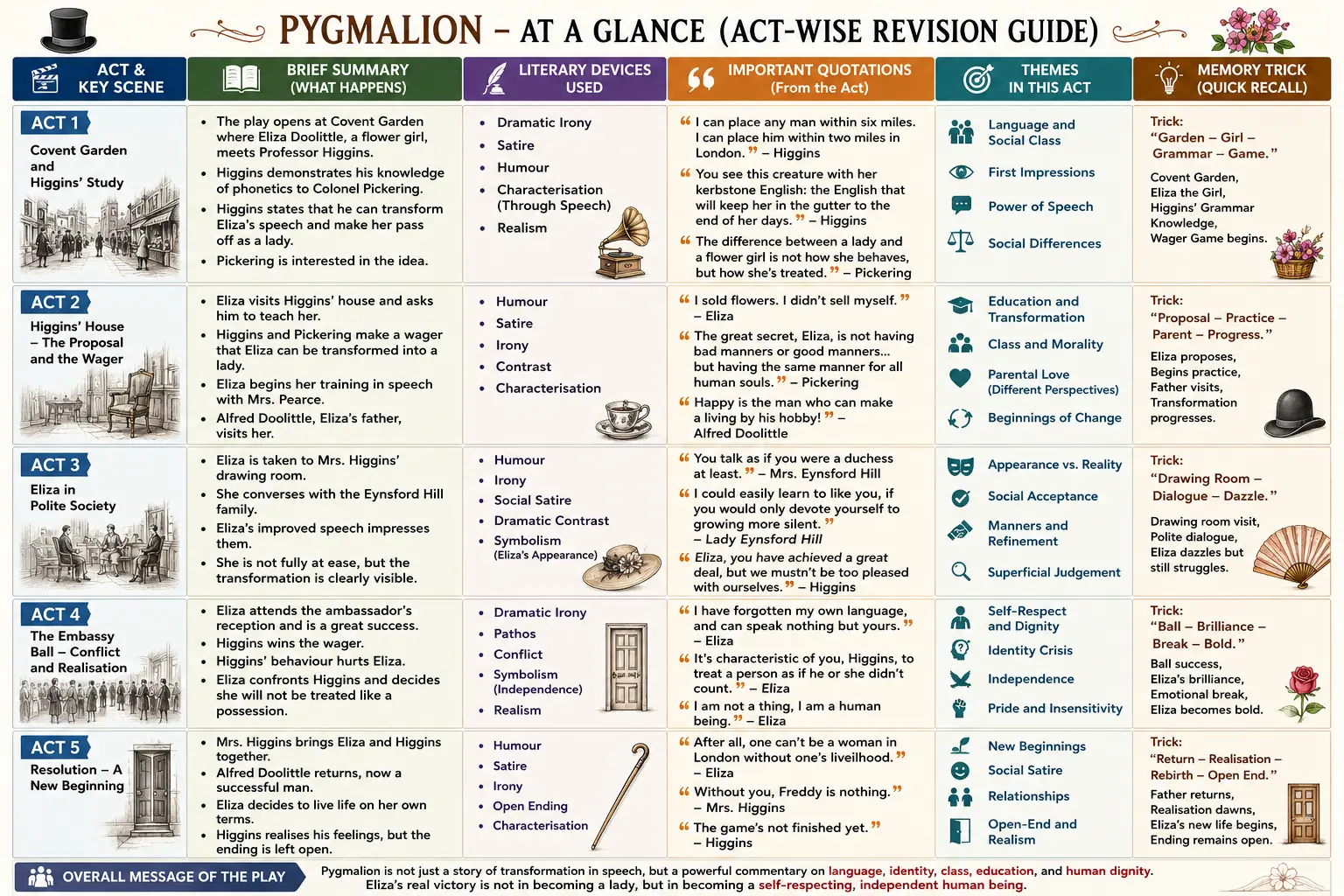
Act 1 – The opening at Covent Garden, introduction of the major characters, and Higgins’ remarkable skill in phonetics.
Act 2 – Eliza’s arrival at Higgins’ laboratory, the beginning of the transformation experiment, and the conditions of the wager.
Act 3 – Eliza’s early social appearances, the “At Home” scene, and the contrast between appearance and reality.
Act 4 – The emotional conflict between Eliza and Higgins after the ambassador’s reception and Eliza’s growing self-respect.
Act 5 – The final confrontation, Eliza’s independence, Alfred Doolittle’s transformation, and the play’s thought-provoking conclusion.
Whether you are completing homework, revising difficult scenes, or preparing for school examinations and the ISC board examination, these act-wise workbook solutions are designed to help you understand the play, strengthen your literary interpretation, and improve your answer-writing skills with confidence.
Get The Official Workbook Home Delivered :
Buy Physical Book On Amazon
Buy Physical Book On Amazon
Explore Other Workbook Solutions
Browse chapter-wise ISC workbook solutions for Rhapsody & Prism and Total English for Classes 11 and 12.
What’s Included On This Page
This page has been designed as a complete study resource for ISC Pygmalion, bringing together everything a student needs to understand the play while preparing workbook exercises and examinations. Instead of searching different websites for workbook answers, summaries, character analysis, or revision notes, you can find all the essential study material organised in one place for quick and effective learning.
Here, you’ll find act-wise workbook answers for all five acts of Pygmalion, including solutions to extract-based questions, multiple-choice questions (MCQs), short-answer questions, and long-answer exercises from the prescribed workbooks. Every answer has been prepared in a simple, examination-oriented style that not only provides the correct response but also explains the context and literary significance wherever necessary.
Along with workbook solutions, this page also includes act summaries, major character analysis, important themes, literary devices, significant quotations, dramatic techniques, revision strategies, examination tips, and other learning resources that help students appreciate George Bernard Shaw’s play beyond the workbook. These resources are intended to strengthen conceptual understanding, improve literary interpretation, and develop effective answer-writing skills for the ISC English Literature examination.
Whether you are studying Pygmalion for the first time, revising before a class test, preparing for pre-board examinations, or getting ready for the ISC board examination, this page serves as a reliable companion throughout your preparation. Simply choose the required act and explore carefully organised workbook answers together with comprehensive study material designed to make learning easier, more meaningful, and examination-ready.
Why These Workbook Answers Help ISC Students
Studying Pygmalion requires much more than learning the plot or memorising workbook answers. George Bernard Shaw’s play explores complex ideas about language, identity, social class, education, and human relationships through witty dialogue and subtle satire. These workbook solutions are designed to simplify difficult scenes, explain important conversations, and help students understand the deeper meaning behind every act in a clear and student-friendly manner.
Rather than encouraging rote learning, the solutions focus on building a strong conceptual understanding of the play. Along with accurate workbook answers, students can explore the context of important extracts, character development, major themes, literary devices, dramatic techniques, and significant quotations that are essential for literary appreciation. This approach helps students not only complete workbook exercises correctly but also write thoughtful, well-supported answers in school examinations and the ISC English Literature examination.
Whether you are preparing homework, revising before a class test, or strengthening your understanding for the board examination, these act-wise workbook solutions provide a structured and reliable learning resource. Teachers can use the explanations during classroom discussions, while parents can confidently guide students through difficult scenes and literary concepts. By combining accurate workbook answers with clear explanations and examination-oriented insights, this page helps students develop both confidence and a deeper appreciation of George Bernard Shaw’s Pygmalion.
About George Bernard Shaw’s Pygmalion
George Bernard Shaw (1856–1950) was one of the most influential playwrights, literary critics, and social thinkers of the twentieth century. Born in Dublin, Ireland, Shaw became famous for writing plays that combined humour, wit, and thought-provoking social criticism. Rather than writing purely for entertainment, he used drama to question social conventions, challenge accepted beliefs, and encourage audiences to think critically about issues such as class, education, gender equality, poverty, and human behaviour. In recognition of his outstanding contribution to literature, he was awarded the Nobel Prize in Literature in 1925.
Among Shaw’s many plays, Pygmalion remains his most celebrated and widely studied work. First performed in 1913, the play was inspired by the Greek myth of Pygmalion but transformed into a modern social comedy set in London. Instead of sculpting a statue into a living woman, Shaw presents the story of Professor Henry Higgins, a phonetics expert who attempts to transform Eliza Doolittle, a flower girl with a strong Cockney accent, into a refined lady by changing her speech and manners. Through this fascinating experiment, Shaw raises important questions about identity, social class, education, self-respect, and the power of language in shaping a person’s opportunities.
One of the most remarkable features of Pygmalion is that it goes beyond the story of Eliza’s transformation. Shaw uses humour, irony, realistic dialogue, and memorable characters to expose the rigid British class system and challenge the belief that a person’s worth can be judged by appearance, accent, or social background. As the play progresses, readers realise that the true transformation is not merely Eliza’s pronunciation but her growing confidence, independence, and sense of self-worth.
Today, Pygmalion continues to be an important part of the ISC English Literature syllabus because of its timeless themes and literary richness. The play introduces students to dramatic techniques, character development, satire, and social criticism while encouraging them to think deeply about human relationships and society. Understanding George Bernard Shaw’s purpose and the ideas behind Pygmalion enables students to appreciate the play beyond its plot and write more thoughtful, analytical answers in the ISC English Literature examination.
Meet the Major Characters Of Pygmalion
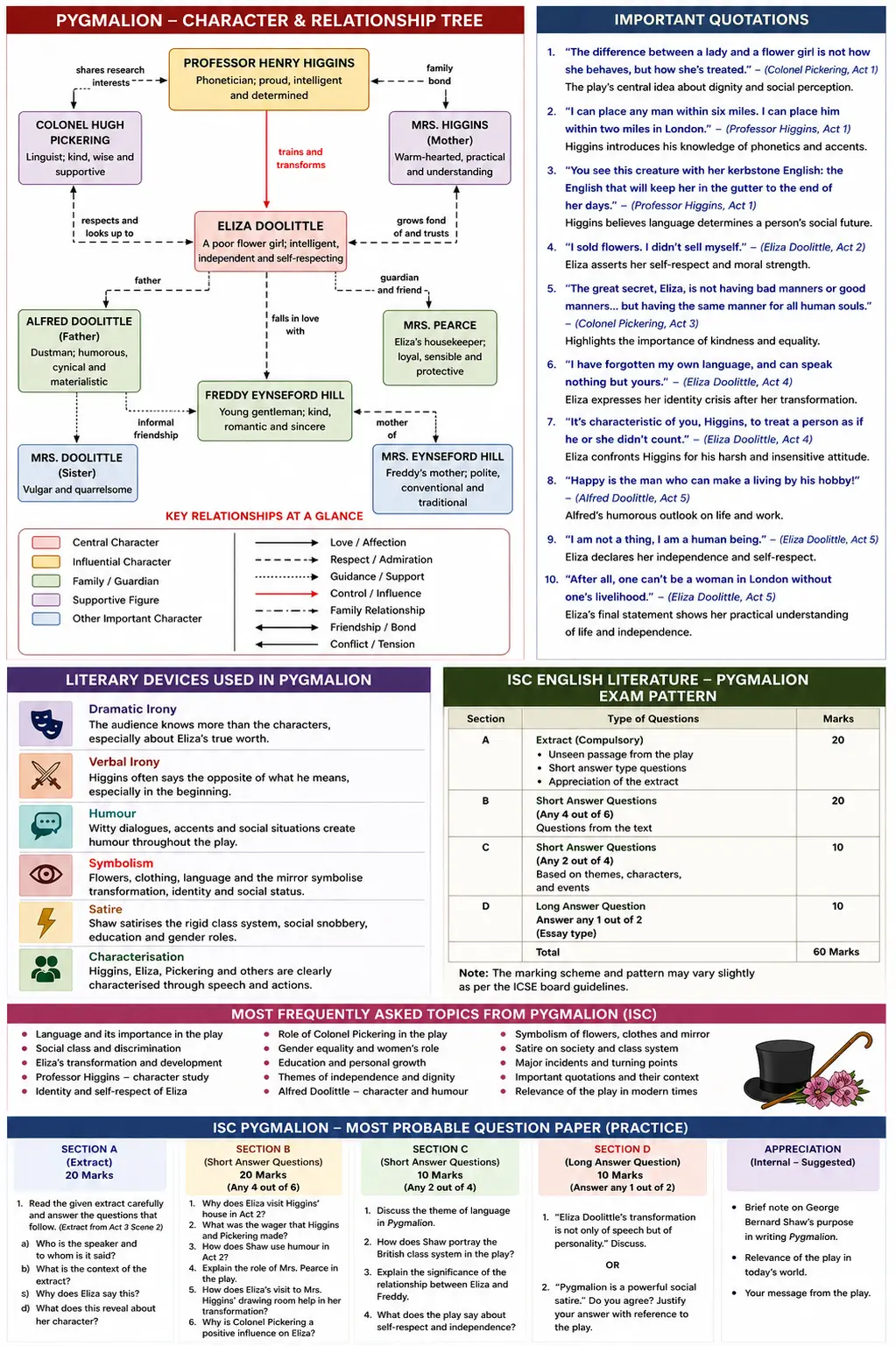
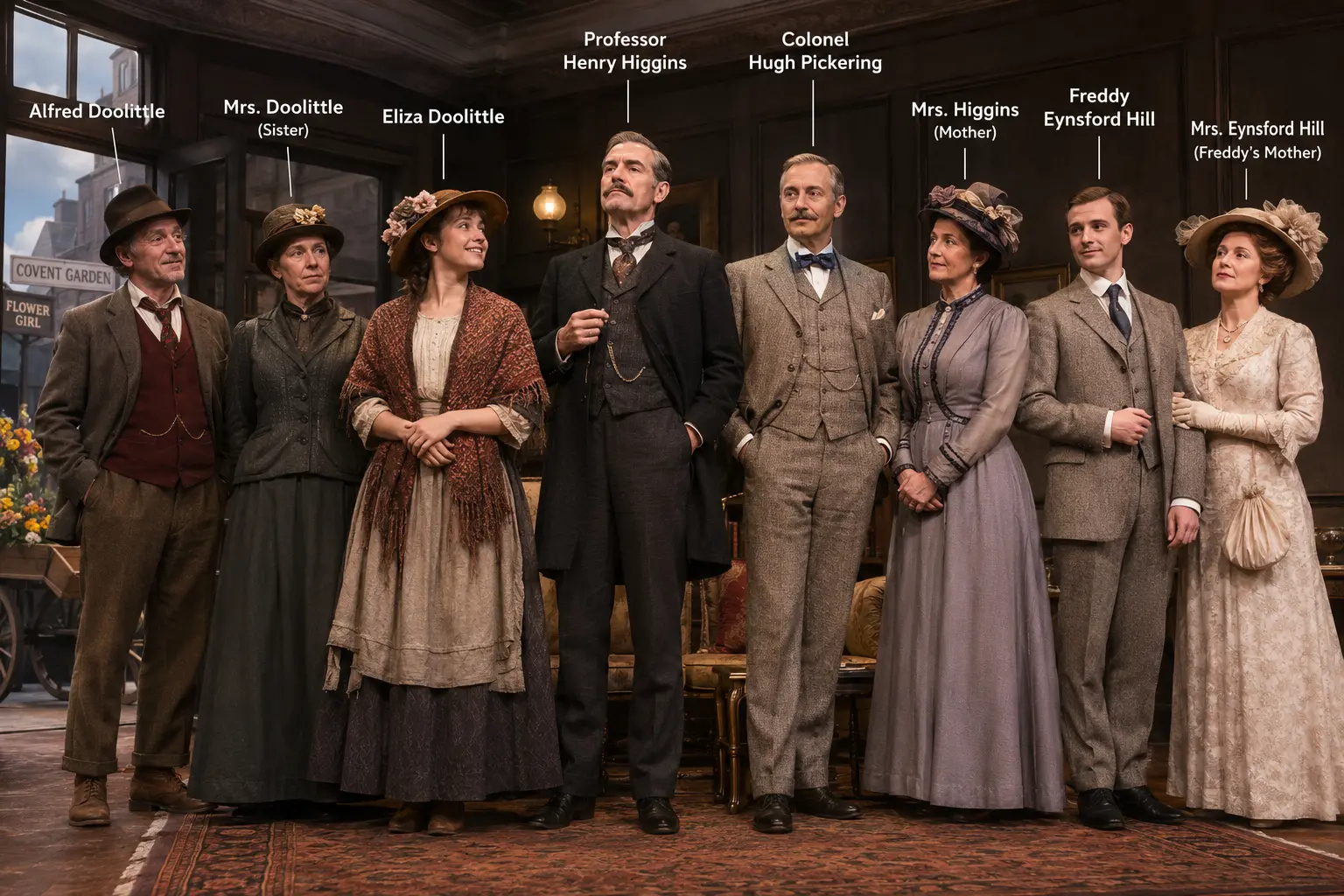
The characters in Pygmalion are central to George Bernard Shaw’s exploration of language, identity, social class, and personal transformation. Each character contributes to the development of the plot while representing different aspects of Edwardian society. Understanding their personalities, relationships, and significance will help students appreciate the play more deeply and answer character-based questions confidently in the ISC English Literature examination.
Character
Role in the Play
Brief Description
Eliza Doolittle
Protagonist
A young flower girl with a strong Cockney accent who undergoes a remarkable transformation through Higgins’ phonetic training. Intelligent, determined, and self-respecting, Eliza gradually discovers her own identity and independence.
Professor Henry Higgins
Phonetician & Linguist
A brilliant expert in phonetics who believes that speech determines social status. Although highly intelligent, he is often arrogant, blunt, and insensitive to the feelings of others.
Colonel Pickering
Gentleman & Linguist
A courteous and respectful scholar of Indian dialects who supports Higgins’ experiment. His kindness and good manners play an important role in Eliza’s personal growth and confidence.
Alfred Doolittle
Eliza’s Father
A dustman with a lively personality and unconventional views on morality. His unexpected rise in social status adds humour while reinforcing Shaw’s criticism of class distinctions.
Mrs Higgins
Higgins’ Mother
A wise, compassionate, and practical woman who often acts as the voice of reason. She understands people’s emotions better than Higgins and offers valuable guidance throughout the play.
Freddy Eynsford Hill
Admirer of Eliza
A polite and affectionate young man who becomes deeply devoted to Eliza. His admiration reflects genuine respect rather than concern for social status or wealth.
Mrs Pearce
Higgins’ Housekeeper
Higgins’ efficient and sensible housekeeper who manages his household and frequently reminds him to treat Eliza with greater consideration and respect.
Mrs Eynsford Hill
Freddy’s Mother
A well-bred but financially struggling lady who tries to maintain social dignity despite her family’s declining fortunes.
Clara Eynsford Hill
Freddy’s Sister
A fashionable young woman who is eager to appear modern and sophisticated. Her conversations reveal contemporary social attitudes and changing ideas about manners and language.
Nepommuck
Former Student of Higgins
A gifted linguist and interpreter who appears at the ambassador’s reception. His admiration for Higgins’ phonetic skill highlights the success of Eliza’s remarkable transformation.
Complete Act-wise Overview
Pygmalion is a five-act play that traces Eliza Doolittle’s remarkable journey from a poor flower girl to a confident and self-respecting woman. While the transformation of her speech forms the central plot, George Bernard Shaw uses each act to explore deeper themes such as social class, identity, education, language, and human dignity. Understanding the purpose of each act helps students follow the development of the story and appreciate Shaw’s social criticism more effectively.
Act 1 – The Unexpected Meeting
The play opens on a rainy evening outside St. Paul’s Church, Covent Garden, where people take shelter after a theatre performance. A flower girl, Eliza Doolittle, is selling flowers when she meets Professor Henry Higgins, an expert in phonetics, and Colonel Pickering, a fellow linguist. Higgins astonishes everyone by identifying people’s places of origin simply from their accents. Intrigued by Eliza’s speech, he confidently claims that he could teach her to speak like a duchess. This act introduces the principal characters, establishes the central idea of language and social class, and lays the foundation for the transformation that follows.
Act 2 – The Beginning of the Experiment
Eliza visits Higgins’ house with the hope of improving her speech so that she can earn a better living by working in a flower shop. Amused by her determination, Higgins accepts the challenge after making a wager with Colonel Pickering that he can transform Eliza into a refined lady capable of passing as a member of high society. As Eliza begins her lessons in pronunciation, manners, and etiquette, Shaw also introduces Alfred Doolittle, whose lively conversation adds humour while highlighting the play’s criticism of conventional morality and social class.
Act 3 – Eliza’s First Social Test
After months of training, Higgins decides to test Eliza’s progress by introducing her into polite society. She accompanies Higgins and Pickering to Mrs. Higgins’ drawing room, where she meets members of the Eynsford Hill family. Although Eliza speaks with remarkable pronunciation, her unusual choice of topics and expressions creates both humour and confusion. The act demonstrates that learning correct speech alone is not enough to become socially refined, while also revealing society’s tendency to judge people based on appearances and manners.
Act 4 – Conflict and Self-Realisation
Following the success of the ambassador’s reception, Higgins proudly celebrates winning the wager but fails to acknowledge Eliza’s efforts or consider her future. Feeling ignored and treated merely as part of an experiment, Eliza confronts Higgins in one of the play’s most emotionally powerful scenes. Their argument marks a turning point in the story, as Eliza begins to recognise her own dignity, independence, and self-worth instead of remaining dependent on Higgins’ approval.
Act 5 – Independence and an Open Ending
The final act brings together the major characters at Mrs. Higgins’ home, where the misunderstandings surrounding Eliza’s disappearance are resolved. Alfred Doolittle’s unexpected change in social status provides humour while reinforcing Shaw’s criticism of the class system. More importantly, Eliza confidently asserts her independence and refuses to be treated as Higgins’ creation. Rather than offering a conventional romantic ending, Shaw concludes the play with an open ending that encourages readers to reflect on freedom, identity, mutual respect, and the true meaning of personal transformation.
Major Themes Of Pygmalion
George Bernard Shaw’s Pygmalion is much more than the story of Eliza Doolittle’s transformation. Through its engaging characters and witty dialogue, the play explores several timeless themes that continue to remain relevant today. Understanding these themes helps students appreciate Shaw’s purpose and write well-developed analytical answers in the ISC English Literature examination.
Theme
Brief Explanation
Language and Social Class
Shaw shows how a person’s accent and manner of speaking often determine how society judges their education, status, and opportunities.
Transformation and Self-Discovery
Eliza’s journey is not just about learning refined speech but about developing confidence, independence, and a strong sense of self-worth.
Identity
The play questions whether a person’s identity is shaped by birth, appearance, language, or individual character and choices.
Class Distinction and Social Mobility
Shaw criticises the rigid British class system and demonstrates that social status is often based on superficial differences rather than true ability or character.
Education and Personal Growth
Through Higgins’ experiment, Shaw highlights how education and guidance can transform a person’s life while also emphasising the importance of respect and empathy.
Human Dignity and Self-Respect
As the play progresses, Eliza demands to be treated with dignity, proving that every individual deserves respect regardless of social background.
Gender Roles and Women’s Independence
Shaw presents Eliza as a strong and independent woman who refuses to remain dependent on Higgins, challenging traditional expectations of women in society.
Appearance versus Reality
The play illustrates how outward appearance and refined speech can influence people’s opinions, often hiding a person’s true character and abilities.
Power and Control
Higgins attempts to shape Eliza according to his own vision, raising questions about authority, influence, and an individual’s right to make independent decisions.
Satire of Society
Through humour and irony, Shaw exposes the weaknesses of social conventions, class prejudice, and people’s tendency to judge others based on external qualities rather than merit.
Study Tip: While preparing for examinations, do not study the themes in isolation. Try to connect each theme with the major characters, important incidents, significant quotations, and Shaw’s social criticism. This approach will help you write more analytical and well-supported answers in ISC English Literature examinations.
Major Literary Devices Of Pygmalion
George Bernard Shaw employs a wide range of literary and dramatic techniques to make Pygmalion both entertaining and thought-provoking. These devices enrich the play’s humour, strengthen its social criticism, and help develop the characters and themes. Understanding how these techniques function is essential for literary appreciation and frequently helps students answer analytical and extract-based questions in the ISC English Literature examination.
Literary Device
Usage in Pygmalion
Importance
Satire
Shaw criticises the British class system, social conventions, and people’s obsession with accent and status through humour and irony.
Highlights the weaknesses of society while encouraging readers to question social prejudice.
Irony
Many situations and conversations produce outcomes that differ from expectations, especially in Higgins’ treatment of Eliza and Alfred Doolittle’s unexpected rise in status.
Creates humour while reinforcing the play’s social criticism.
Humour
Witty dialogue, amusing situations, and the contrasting personalities of the characters keep the play engaging.
Makes serious social issues accessible and entertaining for the audience.
Symbolism
Eliza’s transformation, her change in speech, clothing, and behaviour symbolise personal growth, identity, and social mobility.
Adds deeper meaning to the play beyond the surface story.
Characterisation
Shaw develops each character through speech, actions, and interactions rather than lengthy descriptions.
Helps readers understand the personalities, motivations, and development of the major characters.
Dialogue
Most ideas are presented through lively conversations instead of narration.
Advances the plot, reveals character traits, and expresses Shaw’s opinions on society.
Foreshadowing
Early conversations, particularly Higgins’ confidence in transforming Eliza, hint at the events that unfold later in the play.
Builds curiosity and prepares readers for important developments.
Contrast
Shaw contrasts characters such as Higgins and Pickering, as well as Eliza before and after her transformation.
Emphasises differences in personality, values, and social attitudes.
Allusion
The play’s title refers to the Greek myth of Pygmalion, whose sculpture comes to life.
Connects the modern story with a classical myth while highlighting the idea of transformation.
Realism
The play portrays everyday life, realistic conversations, and ordinary social situations instead of romantic fantasy.
Makes the characters and themes believable and relevant, strengthening Shaw’s social message.
Symbols in Pygmalion
Although Pygmalion is primarily a realistic drama, George Bernard Shaw uses several objects and ideas symbolically to reinforce the play’s major themes of identity, social class, education, and personal transformation. Understanding these symbols helps students appreciate the deeper meaning of the play and write more analytical answers in the ISC English Literature examination.
Symbol
Symbolic Meaning
Significance in the Play
Flowers
Innocence, livelihood, and Eliza’s humble social background.
At the beginning of the play, Eliza earns her living by selling flowers. As she transforms, the flowers remind readers of her origins and highlight the contrast between her birth and her later social identity.
Language (Speech & Accent)
Identity, education, and social status.
Shaw presents language as the most powerful symbol in the play. Eliza’s change in speech transforms the way society perceives her, demonstrating that accent often influences social acceptance more than character.
The Bath
Cleansing, renewal, and a new beginning.
Mrs Pearce insists that Eliza bathe before beginning her lessons. This represents the first step in her physical and symbolic transformation into a refined and confident individual.
Clothes
Social identity and outward appearance.
Throughout the play, changes in Eliza’s clothing reflect her changing social position. Shaw suggests that society often judges people by appearance rather than by their true worth or abilities.
The Mirror
Self-awareness and personal identity.
Although not a dominant object in the play, the idea of seeing oneself differently reflects Eliza’s growing confidence and changing perception of her own identity as the transformation progresses.
Money
Economic power, social privilege, and independence.
Money influences many relationships in the play—from Eliza’s desire for a better livelihood to Alfred Doolittle’s unexpected wealth. Shaw uses it to question whether financial success truly brings happiness or social freedom.
Chocolate
Luxury, kindness, and entry into a new social world.
For Eliza, drinking chocolate in Higgins’ home is a completely new experience. It symbolises the comforts and privileges of upper-class life, while also marking the beginning of her journey into an unfamiliar social environment.
Social Issues Raised In Pygmalion
One of the reasons Pygmalion continues to be studied today is its powerful exploration of important social issues that remain relevant even in the modern world. Through realistic characters, witty dialogue, and sharp satire, George Bernard Shaw encourages readers to question social prejudices and think critically about the values of society. Understanding these issues helps students appreciate the deeper purpose of the play and write well-developed analytical answers in the ISC English Literature examination.
Social Issue
How Shaw Explores It in Pygmalion
Class System
Shaw criticises the rigid British class system by showing how people are judged according to their accent, appearance, and manners rather than their abilities or character. Eliza’s transformation proves that social class is often based on perception rather than merit.
Gender Equality
Through Eliza’s personal growth, Shaw challenges the traditional role of women in society. By the end of the play, Eliza chooses dignity and independence instead of remaining dependent on Higgins, reflecting her strength and self-respect.
Education
The play presents education as a powerful tool for personal growth and social mobility. Eliza’s training demonstrates how knowledge and proper guidance can transform a person’s confidence, opportunities, and future.
Language and Accent
Shaw highlights how speech and pronunciation influence the way society judges individuals. Through Higgins’ phonetic experiment, the play questions whether accent should determine a person’s social status or worth.
Identity
As Eliza changes her speech and behaviour, she begins to question who she truly is. Shaw explores whether identity is shaped by birth, society, education, or one’s own choices and self-belief.
Poverty and Social Inequality
Eliza and Alfred Doolittle represent the struggles of the working class. Shaw contrasts their lives with those of the upper class to expose economic inequality and the limited opportunities available to the poor.
Respect and Human Dignity
One of the play’s central messages is that every individual deserves respect, regardless of social background. Eliza’s demand to be treated with dignity highlights the importance of recognising people’s humanity rather than judging them by class or appearance.
Important Quotations From Pygmalion
George Bernard Shaw uses memorable dialogues throughout Pygmalion to reveal the personalities of his characters and communicate the play’s major themes of language, identity, class, education, and self-respect. The following quotations are among the most significant for understanding the play and are useful while preparing for character-based and analytical questions in the ISC English Literature examination.
Important Quotation
Speaker
Significance
“The difference between a lady and a flower girl is not how she behaves, but how she’s treated.”
Colonel Pickering
One of the central ideas of the play. It highlights that respect and treatment often shape a person’s confidence and identity more than social background.
“I can place any man within six miles. I can place him within two miles in London.”
Professor Henry Higgins
Demonstrates Higgins’ extraordinary knowledge of phonetics and introduces the importance of language and accent in determining social identity.
“You see this creature with her kerbstone English: the English that will keep her in the gutter to the end of her days.”
Professor Henry Higgins
Shows Higgins’ belief that language determines social opportunities and introduces the transformation experiment.
“I sold flowers. I didn’t sell myself.”
Eliza Doolittle
Highlights Eliza’s dignity, self-respect, and moral strength. It is one of the most powerful statements about her character.
“I’m a good girl, I am.”
Eliza Doolittle
Reflects Eliza’s innocence and her desire to be respected despite her humble social background.
“The great secret, Eliza, is not having bad manners or good manners… but having the same manner for all human souls.”
Colonel Pickering
Emphasises equality, kindness, and respect for every individual regardless of social class.
“Happy is the man who can make a living by his hobby!”
Alfred Doolittle
Reflects Doolittle’s humorous outlook on life while commenting on work, society, and personal freedom.
“I have forgotten my own language, and can speak nothing but yours.”
Eliza Doolittle
Reveals Eliza’s identity crisis after her transformation and her feeling of belonging neither to her old world nor to the new one.
“I am a common ignorant girl, and in my station I have to be respectable.”
Eliza Doolittle
Shows Eliza’s understanding of morality and her determination to preserve her self-respect despite poverty.
“Without you, Freddy is nothing.”(often paraphrased in discussions about Freddy’s dependence on Eliza)
Mrs. Higgins (contextual discussion of relationships)
Highlights Eliza’s growing independence and the changing relationships among the characters in the final act.
₹ 299.00–₹ 399.00Price range: ₹ 299.00 through ₹ 399.00
Select options
This product has multiple variants. The options may be chosen on the product page
ISC Examination Pattern For Pygmalion
Pygmalion forms an important part of the ISC Mordern English Literature curriculum, where students are expected not only to know the story but also to demonstrate their ability to interpret characters, themes, dramatic techniques, and George Bernard Shaw’s social criticism. The examination places greater emphasis on analytical understanding than on memorising answers. Students are assessed on their ability to explain the context of extracts, analyse character development, identify literary techniques, and support their arguments with relevant references from the play.
While the exact distribution of questions may vary from year to year, questions based on Pygmalion generally assess the following areas:
Area of Assessment
What Students Should Prepare
Extract-based Questions
Explain the context of the given extract, identify the speaker and listener, discuss its significance, and relate it to the events of the play.
Character-based Questions
Analyse the personalities, relationships, development, and significance of major characters such as Eliza Doolittle, Henry Higgins, Colonel Pickering, Alfred Doolittle, and Mrs. Higgins.
Theme-based Questions
Understand major themes including language and social class, identity, education, transformation, gender equality, human dignity, and social mobility.
Literary & Dramatic Techniques
Revise Shaw’s use of satire, irony, humour, symbolism, realism, dialogue, characterisation, and dramatic structure.
Important Quotations
Learn significant quotations along with the speaker, context, and their relevance to the major themes and character development.
Act-wise Understanding
Be familiar with the important incidents, turning points, and dramatic significance of all five acts instead of studying isolated scenes.
Critical Appreciation
Develop the ability to explain Shaw’s purpose, social criticism, and the relevance of the play in both its historical and modern contexts.
Examination Preparation Tips
Read every act carefully before referring to the workbook answers.
Always understand the context of important extracts instead of memorising isolated answers.
Connect characters, themes, quotations, and literary devices while writing long answers.
Support analytical answers with relevant textual references wherever appropriate.
Revise important scenes, turning points, and character relationships regularly.
Practise writing clear, well-organised answers within the expected time limit
Study Tip: In the ISC English Literature examination, examiners generally reward clear interpretation, logical organisation, and textual understanding rather than rote memorisation. Students who explain the significance of an incident, relate it to the play’s themes, and support their answers with appropriate references are better placed to score well.
Loved By 528.4k Students
Frequently Tested Areas By ISC
While the exact questions vary from year to year, certain concepts from each act of Pygmalion are consistently emphasised in school assessments, pre-board examinations, and the ISC English Literature examination. Students should revise these areas thoroughly to strengthen their understanding of the play and improve their analytical and extract-based answer writing.
Act
Frequently Assessed Concepts
Act 1
Opening scene at Covent Garden, Higgins’ expertise in phonetics, first meeting of Higgins and Eliza, introduction of Colonel Pickering, significance of language and accent, social class distinctions, setting and atmosphere.
Act 2
Eliza’s decision to learn proper speech, Higgins and Pickering’s wager, beginning of Eliza’s transformation, Mrs. Pearce’s role, Alfred Doolittle’s visit, themes of education, class, and personal transformation.
Act 3
Eliza’s first appearance in polite society, Mrs. Higgins’ drawing room, conversations with the Eynsford Hill family, appearance versus reality, humour and irony, Eliza’s progress and remaining social awkwardness.
Act 4
Ambassador’s reception (as discussed), Higgins’ attitude after winning the wager, Eliza’s emotional confrontation with Higgins, identity crisis, self-respect, independence, turning point in Eliza’s character development.
Act 5
Mrs. Higgins’ mediation, Alfred Doolittle’s changed social position, Eliza’s assertion of independence, Higgins and Eliza’s relationship, open ending, Shaw’s criticism of conventional social and romantic expectations.
Smart Revision Strategy
Revising Pygmalion effectively requires more than simply reading the workbook answers. Since the ISC English Literature examination focuses on interpretation, character analysis, themes, and dramatic significance, students should revise the play in a systematic manner. The following strategy will help you strengthen your understanding, improve answer-writing skills, and revise the entire play efficiently before examinations.
1. Revise the Play Act by Act
Begin by revising one act at a time instead of studying the entire play together. Understand the sequence of events, major conversations, important turning points, and the dramatic significance of each act before moving to the next.
2. Strengthen Your Character Analysis
Prepare concise notes on the major characters, including their personality traits, relationships, development, and contribution to the play. Pay special attention to Eliza Doolittle, Professor Higgins, Colonel Pickering, Alfred Doolittle, and Mrs. Higgins, as they frequently form the basis of analytical questions.
3. Connect Themes with Important Incidents
Rather than memorising themes separately, relate them to important scenes from the play. Revise how Shaw develops ideas such as language and social class, identity, transformation, education, gender equality, and human dignity through the actions and conversations of the characters.
4. Practise Extract-based Questions
Extract-based questions are an important part of ISC English Literature. While revising each extract, always identify:
The speaker and the listener.
The context of the conversation.
Its significance in the play.
The themes and character development reflected in the extract.
5. Revise Important Quotations
Learn the important quotations along with who says them, when they are spoken, and why they are significant. Understanding the context is more valuable than memorising quotations without knowing their relevance.
6. Review Literary and Dramatic Techniques
Revise Shaw’s use of satire, irony, humour, symbolism, characterisation, realism, and dialogue. Understanding how these techniques support the themes of the play will help you write stronger literary appreciation answers.
7. Practise Writing Analytical Answers
Finally, attempt workbook questions and examination-style questions within a time limit. Focus on writing well-structured answers supported by relevant textual references rather than reproducing memorised points. Regular practice improves both confidence and presentation, two qualities that are highly valued in the ISC English Literature examination.
Exam Preparation Tips
Success in the ISC English Literature examination depends on understanding the play rather than memorising prepared answers. Pygmalion is rich in character development, social criticism, humour, and dramatic techniques, so students should focus on analysing the text and supporting their answers with appropriate references. The following tips will help you prepare more effectively and improve your overall performance in examinations.
Read the play carefully before referring to workbook answers. Understanding the sequence of events and the context of each act makes literary analysis much easier.
Prepare every act thoroughly. Do not skip any scene, as important extracts and analytical questions may be based on any part of the play.
Understand the major characters in depth. Focus on their personality traits, relationships, motivations, development, and contribution to the themes of the play.
Revise the major themes regularly. Pay special attention to language and social class, identity, education, transformation, gender equality, human dignity, and social mobility.
Practise extract-based questions. Always identify the speaker, listener, context, significance, and connection with the overall play before writing your answer.
Learn important quotations with their context. Instead of memorising quotations alone, understand when they are spoken and how they support your answer.
Revise literary and dramatic techniques. Be familiar with Shaw’s use of satire, irony, humour, symbolism, realism, dialogue, and characterisation.
Support long answers with textual references. Referring to important incidents, conversations, or quotations strengthens your literary analysis and demonstrates a better understanding of the play.
Write answers in a clear and organised manner. Begin with the context, explain the main points logically, and conclude with the significance of the incident or idea wherever appropriate.
Practise previous examination-style and workbook questions. Regular writing practice improves confidence, answer presentation, and time management before the ISC English Literature examination.
Study Tip: The highest-scoring answers are those that combine accurate textual knowledge, logical explanation, literary appreciation, and relevant references from the play. Focus on understanding George Bernard Shaw’s purpose behind each scene rather than simply memorising prepared answers. This approach will help you answer both workbook exercises and examination questions with greater confidence and clarity.
Important Practice Questions
The following questions have been carefully prepared in the style of ISC English Literature examinations. They focus on important characters, themes, dramatic techniques, and significant incidents from each act of Pygmalion. Practising these questions will help you strengthen your conceptual understanding and improve your analytical answer-writing skills for school examinations and the ISC English Literature examination.
Act 1
Explain how the opening scene at Covent Garden introduces the central themes of language and social class in Pygmalion.
Discuss the first meeting between Eliza Doolittle, Professor Higgins, and Colonel Pickering. Why is this meeting significant to the development of the play?
How does George Bernard Shaw use Professor Higgins’ knowledge of phonetics to introduce the main idea of the play?
Analyse Eliza Doolittle’s character as presented in Act 1. What first impression does she create?
Act 2
Why does Eliza visit Professor Higgins’ house? Explain the importance of this decision in the development of the plot.
Discuss the wager between Higgins and Colonel Pickering. What does it reveal about their personalities?
Analyse the character of Alfred Doolittle in Act 2. How does Shaw use him to criticise conventional morality and the class system?
Explain the significance of Mrs. Pearce’s role in Act 2. How does she differ from Professor Higgins?
Act 3
Why is Eliza’s visit to Mrs. Higgins’ drawing room considered an important stage in her transformation?
Explain how Shaw uses humour and irony during Eliza’s conversation with the Eynsford Hill family.
“Correct pronunciation alone cannot make a person truly refined.” Discuss this statement with reference to Act 3.
Analyse Mrs. Higgins’ role in the play. How does she differ from Higgins in understanding Eliza?
Act 4
Explain why Act 4 is considered the turning point of Pygmalion.
Discuss the conflict between Eliza and Higgins after the ambassador’s reception. What causes this confrontation?
How does Eliza emerge as a confident and self-respecting individual in Act 4?
Analyse Higgins’ attitude towards Eliza after winning the wager. Do you agree with his behaviour? Give reasons.
Act 5
Explain how George Bernard Shaw challenges the idea of a conventional happy ending in Act 5.
Discuss Eliza’s final decision. How does it reflect her growth as an independent individual?
Analyse the significance of Alfred Doolittle’s unexpected rise in social status. How does Shaw use this episode to satirise society?
“The real transformation in Pygmalion is not Eliza’s speech but her personality.” Discuss this statement with suitable references to the play.
Comprehensive Analytical Questions
Discuss how language becomes a symbol of power, education, and social identity in Pygmalion.
Compare the personalities of Professor Higgins and Colonel Pickering. How does each influence Eliza’s transformation?
“George Bernard Shaw exposes the weaknesses of the British class system through humour and satire.” Discuss with suitable examples from the play.
Examine the role of Eliza Doolittle as the central character of Pygmalion. How does she develop from the beginning to the end of the play?
Do you think Pygmalion is only a story of transformation? Or is it also a powerful social satire? Justify your answer with reference to the play.
ISC Pygmalion FAQ
Frequently Asked Questions
ISC Pygmalion Workbook Answers FAQs
Find quick answers to the most common questions about our ISC Pygmalion workbook answers, Morning Star and Evergreen workbook solutions, examination preparation, character analysis, themes, literary devices, quotations, and revision resources.
Yes. The workbook answers and study material on this page have been prepared according to the latest ISC English Literature syllabus prescribed for Class 11 and Class 12. The solutions are designed to help students understand George Bernard Shaw's Pygmalion while preparing confidently for school examinations and the ISC board examination.
Yes. This page provides act-wise workbook answers for Acts 1 to 5 of Pygmalion. Students can easily access workbook solutions, extract-based questions, MCQs, short-answer questions, long-answer questions, summaries, and revision material for every act from one organised place.
The workbook solutions have been prepared for students studying from the commonly used Morning Star and Evergreen workbooks prescribed for ISC English Literature. The answers are organised act-wise so that students can easily locate the required exercise.
Yes. Along with workbook solutions, this page also provides act summaries, character analysis, important themes, literary devices, symbolism, significant quotations, revision strategies, examination tips, practice questions, and other learning resources that help students develop a deeper understanding of Pygmalion.
Workbook answers provide an excellent foundation, but students should also understand the characters, themes, dramatic techniques, literary devices, and George Bernard Shaw's social criticism. This page combines workbook solutions with detailed literary explanations to help students write analytical and well-supported examination answers.
Begin by reading each act carefully before referring to the workbook solutions. Understand the sequence of events, revise the important characters and themes, practise extract-based questions, learn significant quotations with their context, and regularly solve examination-style questions. This method develops both conceptual understanding and answer-writing confidence.
Students should prepare all five acts thoroughly, with particular attention to character development, major themes, extract-based questions, dramatic techniques, symbolism, important quotations, and Shaw's social criticism. Understanding the significance of important conversations is often more valuable than memorising answers.
Language is one of the central ideas of the play. George Bernard Shaw demonstrates how pronunciation and accent influence social status, opportunities, and the way people are judged by society. Through Eliza's transformation, the play questions whether language should determine a person's identity or worth.
Focus on explaining the context of important incidents, analysing the characters' motivations, connecting events with major themes, and supporting your answers with relevant textual references. Clear organisation and thoughtful interpretation usually score better than memorised responses.
Yes. Teachers can use the workbook solutions and literary explanations while planning classroom discussions and revision sessions. Parents can also use the simplified explanations to guide students through difficult scenes, important themes, and workbook exercises in a structured manner.
Unlike a conventional answer key that provides only direct solutions, this page has been designed as a complete learning resource. Along with workbook answers, students can explore act summaries, character studies, themes, literary devices, symbolism, important quotations, examination guidance, revision strategies, and practice questions that strengthen both literary appreciation and answer-writing skills.
Yes. The page has been organised to support quick revision as well as detailed study. Students can revise act summaries, important quotations, character analysis, themes, literary devices, examination tips, and workbook answers from one place, making revision more organised and efficient before school examinations and the ISC board examination.
Because this page brings together everything needed to study Pygmalion in one place. Instead of searching different websites for workbook answers, summaries, character analysis, literary devices, themes, quotations, revision notes, and examination guidance, students can use this page as a reliable companion throughout the academic session.