
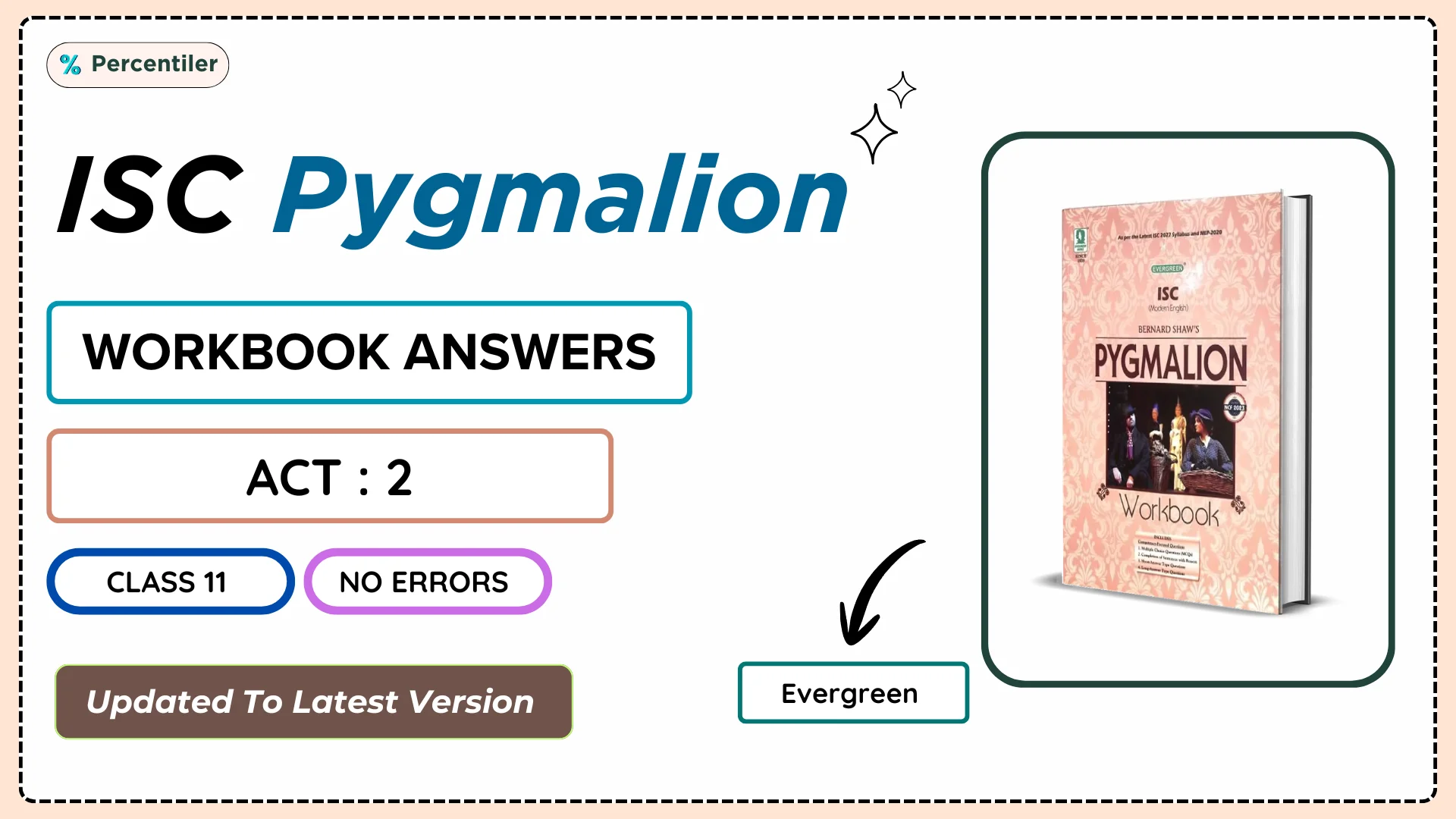
If you’re looking for accurate and easy-to-understand solutions for the Pygmalion workbook, this post on ISC Pygmalion Workbook Answer (Evergreen): Act 2 will help you prepare effectively for your ISC English Literature exams. It contains detailed answers to all the questions from Act 2 of the Evergreen Publishers workbook prescribed for ISC Classes 11 and 12. The solutions are written in a clear and exam-oriented manner to help students understand the plot, characters, important dialogues, and themes of the play. Whether you are revising for school exams or improving your literary analysis, these answers will serve as a reliable study resource.
Table of Contents
Workbook Summary
PLOT DEVELOPMENT
The scene is set in the residence of Prof. Higgins. It is 11:30 a.m. the next day. At his residence, Higgins gives lessons in phonetics to his pupils so that they may pronounce English correctly. Colonel Pickering is staying with him. He feels quite comfortable with Higgins.
Mrs Pearce, Higgins’s housekeeper, announces the arrival of Eliza, the flower-girl. Eliza comes and asks Higgins to teach her so that she may speak like a lady and get a job in the shop of some florist. She offers to pay him his fee. Higgins boasts that he can make her pass off as a duchess. Pickering says that he would pay all the expenses towards her teaching if he succeeds in what he claims. Higgins accepts the challenge.
First, he orders Mrs Pearce to give the girl a thorough bath and dress her in appropriate clothes. Eliza objects and weeps but all her objections are ruled out. Higgins insists on what he has said and she will have to obey him. Eliza is frightened. She tells him that her step-mother does not care at all for her and her father has turned her out saying that she is old enough to take care of herself. Higgins responds rudely and bullies her. Pickering asks him not to hurt the girl’s feelings.
Higgins relents and tells Eliza gently that if she obeys him she will sleep in a proper bedroom, have lots to eat and money to buy chocolates and take rides in taxis. At the end of six months of her teaching, she will go to Buckingham Palace in a carriage, beautifully dressed. “If you refuse this offer, you will be most ungrateful wicked girl …. “
Mrs Pearce takes the girl away. During the time Eliza is away, Pickering asks Higgins, “Are you a man of good character where women are concerned ?” Higgins tells him that he has never been able to pull off well with women. Women, according to him, upset everything. He assures Pickering that for him Eliza will remain a pupil. He has taught most rich and beautiful women; they were no more than blocks of wood for him as he was a block of wood for them.
Mrs Pearce comes back to tell that Eliza has been well-bathed and scrubbed. She asks for permission to attire her in a Japanese dress (the only dress available for her at the moment). Then she advises Higgins not to speak coarse language in front of the girl, and must not leave his things scattered about, for the girl would follow his example.
Mrs Pearce leaves but returns with Alfred Doolittle, Eliza’s father. Dootittle tells Higgins that he has come in search of his daughter who is in his house. Higgins orders him to take his daughter away at once. Doolittle is taken aback by this response. Higgins frightens him by threatening to call the police, for both the father and the daughter have conspired to extort money from him. Doolittle, frightened, says that he has not come there to take away the girl. He has come to beg him to give him five pounds, adding that he knows that his intentions towards him daughter are honourable. Doolittle tries to convince Higgins and Pickering how he deserves to be paid, for he has brought his daughter up, fed and clothed her by the sweat of his brow. Doolittle calls himself “the most undeserving poor”, and that he is a victim of middle-class morality.
In order to get rid of him, Higgins gives him five pounds. He is about to depart when Eliza appears. All are surprised to see the change in her appearance. Doolittle departs after advising Higgins to give the girl a good beating if she ever disobeys.
When Doolittle has gone, Eliza tells Higgins and Pickering that her father is a thorough blackguard, and must have come to beg money for his drinking. He works only when he has no money for his drinks. He and his mistress constantly quarrel and bully each other.
Then Higgins’s method of teaching phonetics to his pupils is explained in detail. Eliza is made to repeat her alphabet and pronounce it correctly. She soon learns to pronounce it correctly. Higgins then asks her to go and practise her lesson by herself. He will give her another lesson at half-past four. In this why, she is taught for months. She has to undergo this ordeal before we see her appearance in London Society of the middle class.

Workbook MCQs
1. How many vowels does Pickering say that he can pronounce correctly ?
(a) thirty-four
(b) twenty-four
(c) one hundred twenty-four
(d) one hundred-thirty
Answer :-(b) twenty-four
2. When Eliza comes to meet Higgins, Mrs Pearce at first wants to
(a) close the door
(b) send her away
(c) offer her a chain and ask to wait
(d) say that Higgins was not there.
Answer :-(b) send her away
3. Higgins says that he will set the girl talking and, “I’ll show you how to make records”. It reveals that he wants the girl to
(a) participate in an experiment
(b) learn correct pronunciation
(c) run away in fear
(d) to earn a living by working in his lab
Answer :-(a) participate in an experiment
4. What does Pickering’s statement “Yes. It’s a fearful strain”, in response to Higgins’ question ‘Tired of listening ?’ reveal about him (Pickering) ?
(a) he likes listening to the experiments in sound time and again.
(b) he is not interested in listening to the sounds.
(c) he is not as keen to listen the sounds as Higgins.
(d) he pretends to be a phonetician.
Answer :-(c) he is not as keen to listen the sounds as Higgins.
5. Which of the following statements uses the same literary device as used in the line, ‘She’s so deliciously low’.
(a) My friend is like a red rose.
(b) The sun smiled happily through the clouds.
(c) The mild wrist strain caused pleasing pains.
(d) Life is a highway and we are the passengers.
Answer :-(c) The mild wrist strain caused pleasing pains.
6. The room where Eliza comes to meet Higgins is
(a) his laboratory where he conducts experiments.
(b) Pickering’s drawing room where he has invited Higgins over supper.
(c) Mrs. Pearce’s house.
(d) Higgins’ kitchen where Mrs Pearce cooks food for him.
Answer :-(a) his laboratory where he conducts experiments.
7. “If I decide to teach you, I’ll be worse than two fathers to you”.
(a) assertive
(b) comic
(c) casual
(d) serious
Answer :-(b) comic
8. Select the option that is true of the Assertion and the reason given below.
Assertion : Higgins tells the girl Eliza to leave and does not want to record her speech.
Reason : He does not want to record the speech of a girl belonging to the working class.
(a) Both the assertion and the reason are true and the reason is the correct explanation of the assertion.
(b) Both the assertion and the reason are true but the reason is not the correct explanation of the assertion.
(c) The assertion is true but the reason is false.
(d) The assertion is false but the reason is true.
Answer :-(c) The assertion is true but the reason is false.
9. What does Eliza Doolittle want ?
(a) a job in Higgins’ laboratory
(b) to work in a flower shop
(c) to buy a pen
(d) to marry Pickering
Answer :-(b) to work in a flower shop
10. Doolittle comes to Professor Higgins –
(a) to get some money
(b) to learn English from Higgins
(c) to ask if his daughter was there at Higgins’ laboratory
(d) to meet Mrs. Pearce.
Answer :-(a) to get some money
11. The way Eliza speaks in a retorting way to Higgins appears –
(a) something serious
(b) strange and amusing
(c) threatening and terrible
(d) as something natural
Answer :-(a) something serious
12. Name the literary device used in the line, “Higgins : Shall we ask this baggage to sit down, or shall we throw her out of the window ?”
(a) smile
(b) metaphor
(c) symbol
(d) oxymoron
Answer :-(b) metaphor
13. The flower girl tells about her coming in a taxi. She tells this with a sense of….
(a) Pride
(b) joy
(c) regret
(d) surprise
Answer :-(a) Pride
14. Even when the flower girl offers to pay Higgins for learning from him, Higgins does not think that the girl is wealthy. Which of the following statements shows this ?
(a) A millionaire has about &15 a day. She earns about half a crown.
(b) She offers me two-fifths of her day’s income.
(c) How much do you propose to pay me for the lessons ?
(d) It is the biggest offer I ever had.
Answer :-(a) A millionaire has about &15 a day. She earns about half a crown.
15. Mrs Pearce says, “Oh, don’t say that, sir : there are more ways than one of turning a girl’s head; and nobody can do it better than Mr Higgins”. These words show that Mrs. Pearce is :
(a) appreciating Higgins
(b) flattering Higgins
(c) making fun of Higgins
(d) being disobedient to Higgins
Answer :-(c) making fun of Higgins
16. Higgins calls Eliza a dragger-tailed guttersnipe’. The literary device used here is :
(a) allusion
(b) simile
(c) metaphor
(d) irony
Answer :-(c) metaphor
17. When Higgins expresses his view that he did not want to hurt Eliza’s feelings and really desired to help her, Mrs Pearce :
(a) appreciates him
(b) criticizes him
(c) cautions him
(d) rebukes him
Answer :-(c) cautions him
18. Which of the following statements uses the same literary device as has been used in the line, “By George Eliza, the streets will be strewn with the bodies of men shooting themselves for your sake before I’ve done with you”.
(a) The pen is mightier than the sword.
(b) The clouds danced and lightning winked across the sky.
(c) I’ve helped him million times.
(d) The flowers swayed shyly sounding soft.
Answer :-(c) I’ve helped him million times.
19. When Higgins tells Mrs Pearce not to buy new clothes for the flower girl Eliza she says, “I wouldn’t have taken them. I can buy my own clothes”. Which trait of her character is revealed here ?
(a) honesty
(b) hardwork
(c) disobedience
(d) self-respect
Answer :-(d) self-respect
20. Select the option that shows the correct relationship between Statement 1 and Statement 2.
Statement 1 : Time enough to think of the future when you have not any future.
Statement 2 : She should think of the future.
(a) 1 is the cause of two
(b) 1 is an example of two
(c) 1 is independent of 2
(d) 1 is the result of 2
Answer :-(d) 1 is the result of 2
21. Higgins says to Eliza. “Eliza : You are to live here for the next six months, learning to speak beautifully, like a lady in a florist shop”.
(a) polite
(b) rude
(c) pleasing
(d) authoritative
Answer :- For Full Workbook Answers – Get The Solutions PDF ( View )
22. Which of the following warnings are given to Eliza by Higgins against being naughty ?
1. Her head will be cut off.
2. She will sleep in the back kitchen.
3. She will be taken by the police.
4. Mrs. Pearce will beat her with a broomstick.
5. The angels will weep for her.
(a) 1 and 5
(b) 2, 3 and 5
(c) 2 and 4
(d) 2 and 5.
Answer :- For Full Workbook Answers – Get The Solutions PDF ( View )
23. Mrs Pearce tells Higgins, “When you get what you call interested in people’s accents, you never think or care what may happen to them or you”. It brings out his character traits of being-
(a) careless and greedy
(b) cruel and selfish
(c) selfish and insensitive
(d) over enthusiastic and selfish
Answer :- For Full Workbook Answers – Get The Solutions PDF ( View )
24. Higgins’ interaction with Eliza before she is taken as a student by him indicates that :
(a) the girl is extremely harsh and disobedient.
(b) it’s not easy to make Higgins accept a new student.
(c) the girl is conscious and cautious about her self-respect.
(d) Mrs Pearce obeys Higgins blindly.
Answer :- For Full Workbook Answers – Get The Solutions PDF ( View )
25. Liza says about the bedroom she is offered at Higgins’ place by Mrs Pearce -“It’s too good for the likes of me”. It shows –
(a) She is happy to get the comfortable room.
(b) She reveals her ignorance about such a room.
(c) her class consciousness.
(d) unwillingness to stay there.
Answer :- For Full Workbook Answers – Get The Solutions PDF ( View )
26. Higgins’ views about women expressed during his conversation with Pickering show that he –
(a) hates women
(b) does not understand women
(c) is indifferent towards them
(d) is insensitive towards women
Answer :- For Full Workbook Answers – Get The Solutions PDF ( View )
27. Mrs Pearce asks Higgins to be particular about his language in front of the flower girl as he uses inappropriate words quite often. It makes his character-
(a) ironical and paradoxical
(b) ideal and interesting
(c) strange but serious
(d) funny
Answer :- For Full Workbook Answers – Get The Solutions PDF ( View )
28. Select the option that correctly lists the bad manners that Mrs Pearce associates with Higgins.
1. He comes for breakfast very late.
2. His coming down to breakfast in his dressing-gown.
3. Eating a lot of food.
4. Eating everything off the same plate.
(a) 1, 3,4
(b) 2, 4, 5
(c) 3, 4, 5
(d) 2, 3,5
Answer :- For Full Workbook Answers – Get The Solutions PDF ( View )
29. Mrs Pearce asks Higgins if Eliza should be given to wear –
(a) Russian dresses
(b) Indian dresses
(c) Clean and costly dresses
(d) Japanese dresses
Answer :- For Full Workbook Answers – Get The Solutions PDF ( View )
30. Pickering’s attitude towards Eliza is –
(a) full of pity
(b) considerate and helpful
(c) indifferent
(d) cruel
Answer :- For Full Workbook Answers – Get The Solutions PDF ( View )
31. Who comes to Higgins to claim that his daughter was there at his (Higgins’) house ?
(a) Freddy
(b) Clara
(c) Alfred Doolittle
(d) a stranger
Answer :- For Full Workbook Answers – Get The Solutions PDF ( View )
32. Eliza’s father comes to take his daughter Eliza home. When Higgins asks him to take away the girl, the father says, What !’ It shows that
(a) he had not expected Higgins to agree and send Eliza with him.
(b) he is happy that he will take his daughter home.
(c) he is not interested in taking his daughter back home.
(d) both (a) and (c).
Answer :- For Full Workbook Answers – Get The Solutions PDF ( View )
33. Higgins tells Pickering that Alfred Doolittle is brought up in Hounslow. How does Alfred feel over it ?
(a) happy
(b) serious
(c) surprised
(d) shocked
Answer :- For Full Workbook Answers – Get The Solutions PDF ( View )
34. Who had told Alfred that his daughter was there at Prof. Higgins’ house ?
(a) Colonel Pickering
(b) Mrs Pearce
(c) Son of Eliza’s landlady
(d) the Taximan
Answer :- For Full Workbook Answers – Get The Solutions PDF ( View )
35. Higgins offers ten pounds to Alfred Doolittle for leaving his daughter Eliza there.
Doolittle wants
(a) much more than that
(b) fifteen pounds
(c) five pounds
(d) fifty pounds
Answer :- For Full Workbook Answers – Get The Solutions PDF ( View )
Complete The Sentences
1. Eliza goes to Higgins’ laboratory because
Answer :-Eliza goes to Higgins’ laboratory because Higgins had claimed to transform her into a duchess and Eliza wants to get training from Higgins to improve her speech to get a job at some flower shop.
2. Mrs Pearce, at first, wanted to send the girl away but she did not do that because.
Answer :-Mrs Pearce, at first, wanted to send the girl away but she did not do that because she thought that Higgins perhaps wanted that girl to talk into his machines.
3. Prof. Higgins wants Pearce to bring the flower girl to his laboratory because
Answer :-Prof. Higgins wants Pearce to bring the flower girl to his laboratory because he wants to record the flower girls speech for experiments.
4. Prof. Higgins’ words about recording the girl’s voice also show that Mrs Pearce also takes part in his experiments on language because
Answer :-Prof. Higgins’ words about recording the girl’s voice also show that Mrs Pearce also takes part in his experiments on language because Higgins tells Mrs. Pearce that he will record the girl’s speech so that Mrs. Pearce can hear it with the written transcript before her.
5. Colonel Pickering looks moved by the looks of the flower girl because
Answer :-Colonel Pickering looks moved by the looks of the flower girl because he shows sympathy for her and offers to spend money on the experiment to transform her into an aristocratic lady.
6. The flower girl asks Higgins not to call her a baggage because
Answer :-The flower girl asks Higgins not to call her a baggage because she is self respecting and assertive.
7. Higgins considers the payment that the girl offers for his lessons to be enormous because
Answer :-Higgins considers the payment that the girl offers for his lessons to be enormous because t is a big amount in relation to her income or financial condition.
8. Higgins appears to be rude and insensitive to the girl as if he dislikes her but actually this is not so because
Answer :-Higgins appears to be rude and insensitive to the girl as if he dislikes her but actually this is not so because he explains to Mrs. Pearce that he infact intended to help the girl.
9. Higgins asks Pearce to take all Eliza’s clothes off and burn them because
Answer :-Higgins asks Pearce to take all Eliza’s clothes off and burn them because he wants Eliza to dress up in a way that makes her look aristocratic and modern.
10. Liza says, “No ! I’ll call the police, I will”, because
Answer :-Liza says, “No ! I’ll call the police, I will”, because Higgins tells Eliza to follow Mrs. Pearce’s instructions and tells Mrs. Pearce to beat Eliza if she does not cooperate with her.
11. Higgins says that he did not express himself clearly because
Answer :- For Full Workbook Answers – Get The Solutions PDF ( View )
12. Higgins asks Pearce that she need not buy new clothes for Eliza because
Answer :- For Full Workbook Answers – Get The Solutions PDF ( View )
13. The girl Liza does not want Higgins to buy her new clothes because
Answer :- For Full Workbook Answers – Get The Solutions PDF ( View )
14. Alfred Doolittle does not want more money and accepts five pounds only because
Answer :- For Full Workbook Answers – Get The Solutions PDF ( View )
15. Mr Pickering looks quite concerned about Eliza because
Answer :- For Full Workbook Answers – Get The Solutions PDF ( View )
Short-Answer Type Questions
I. How is Higgins described in the opening of Act II of Pygmalion? What does it show about the author’s attitude towards Higgins ?
Answer :-In Act II of Pygmalion we get some details about Higgins’ appearance and strange nature. The playwright has described Higgins as an impressive man ‘of forty or thereabouts’. He is dressed in a professional — looking black frockcoat with a white linen collar and black silk tie. He is quite energetic and has keen interest in everything which can be studied in a scientific way. The writer describes him as ‘a person careless about himself and other people, including their feelings.” Despite his age, he is like an ‘impetuous baby’. He has no malice against anyone. The description of Higgins that the playwright has given reveals the writer’s critical attitude towards this character. The writer describes Higgins’ passion for study in a mocking way. The description also points out the fickle-minded and unpredictive nature of Higgins. It shows that the writer’s attitude towards this character is not full of appreciation at all.
II. Mrs Pearce says to the flower girl, “How can you be such a foolish ignorant girl as to think you could afford to pay Mr Higgins ?” What does it reveal about Mrs Pearce’s attitude towards the flower girl ? Why does the flower girl want to pay money to Mr Higgins ?
Answer :-Mrs. Pearce, in a way, criticizes the flower girl for saying that she will pay Higgins for his lessons. The flower girl is very poor and looks dirty. She belongs to the lower sections of society. Mrs. Pearson’s telling the girl that she was ignorant and foolish in believing that she could pay Higgins reveals Mrs. Pearson’s class consciousness. She thinks that a girl belonging to a low class cannot afford to pay a person like Mr. Higgins. It also reveals that she has no sympathy for the flower girl. Her attitude towards this girl is typical of the way upper classes of societies behave with the poor people from the lower classes. They have certain pre-conceived notions about the lower classes of people. The flower girl wants to pay money to Mr. Higgins for his lessons that would transform her into an aristocratic lady. She is to get these lessons to learn aristocratic forms of speech and manners.
III. Does the flower girl Eliza behave in the way Mrs Pearce expected her to behave 2 What is strange in her behaviour with Higgins, in particular ?
Answer :-Mrs. Pearce is a house keeper working with Henry Higgins. The flower girl Eliza visits Higgins to get lessons from him to learn speech and manners. Mrs. Pearce finds her a very poor and common girl with no social status. Mrs. Pearce expects this girl to behave in a subdued and submissive way. But the flower girl Eliza is quite assertive and aggressive in her behaviour. She repeatedly asserts her own views on different things. It is completely opposite of what Mrs. Pearce expected. The flower girl’s behaviour with Higgins is particularly full of defiance, and insulting. She repeatedly expresses her dislikeand resentment against him. Of course, Higgins treats her like an insignificant person, but this girl too, shows no respect for him and continuously displays her distrust in him. She comes to take lessons from him but has nothing like the respect one shows towards one’s teacher. It makes her attitude towards Higgins strange.
IV. Why does Pickering offer to pay for Eliza’s lessons ? What does it show about Pickering ?
Answer :- For Full Workbook Answers – Get The Solutions PDF ( View )
V. What does Higgins offer Eliza for eating ? What does Eliza’s response to this reveal about her ?
Answer :-Higgins offers a chocolate cream to the flower girl. He asks Eliza to eat it. Eliza does not accept the chocolate. She does not want to eat it. Her response to Higgin’s gesture shows that she is suspicious of him. She tells him that she was not going to eat the chocolate as she did not know what was there in the chocolate. She expresses her apprehension in these words, “Ive heard of girls being drugged.” It reveals her fear that Higgins might have mixed something to the chocolate. The girl’s fearful reaction shows that Eliza is a smart and clever girl who does not trust others easily. It also reveals that she does not trust Higgins. Her saying these things clearly in front of Higgins also indicates that she is a straightforward person.
VI. Higgins tells Eliza, “Eliza, do as this lady does : think of other people’s futures; but never think of your own ?” What does it reveal about Higgins’ attitude towards the working class people ?
Answer :- For Full Workbook Answers – Get The Solutions PDF ( View )
Long-Answer Type Questions
I. Prof. Higgins appears to be an ill-mannered person. How does it come forth ? What kind of a contradiction does this reveal in Higgins’ character ?
Answer :-In George Bernard Shaw’s *Pygmalion*, Professor Henry Higgins clearly appears to be an ill-mannered and rude person, and this is shown in many ways throughout the play.
First, Mrs. Pearce, who is Higgins’ housekeeper, often shows concern about his behaviour. She feels that Higgins speaks harshly, uses bad language, and has no proper manners when dealing with others. She tries to remind him that he should behave politely, especially with a young girl like Eliza Doolittle. Her views show that even his own household member finds his behaviour improper.
Second, Mrs. Higgins, who is Henry Higgins’ mother, also expresses disappointment in her son’s behaviour. She knows that he is intelligent and educated, but she is not happy with his lack of social manners. She feels that he behaves like a child who never learned how to respect people in society.
Third, Higgins’ own conversation and behaviour with Eliza Doolittle clearly show his ill manners. He often treats her as an experiment or object rather than a human being. He speaks to her in a rude, commanding tone and ignores her feelings. He does not show proper respect or kindness, even though he is teaching her to become a lady.
This creates a strong contradiction in Higgins’ character. On one hand, he teaches Eliza correct pronunciation, language, and social etiquette. He tries to transform her into a well-mannered lady. But on the other hand, he himself does not follow the basic rules of politeness. This shows that he propagates good manners but does not practice them in his own life, making his character both ironic and inconsistent.
II. How does the conversation between Prof. Higgins and Eliza express Shaw’s treatment of class differences in society of his times ?
Answer :-In George Bernard Shaw’s *Pygmalion*, Eliza Doolittle’s language and speech at the beginning of the play clearly show that she lacks sophistication. She speaks in a rough London dialect, which is often called a “gutter” accent. Her way of speaking is full of slang and incorrect pronunciation, which makes her sound uneducated and lower class in society.
Because of her poor speech, Eliza is unable to get a proper job as an assistant in a flower shop. The shop owner judges her based on her language and appearance, and he refuses to hire her. This shows how strongly society connects good speech with respect and employment opportunities.
Professor Higgins often points out Eliza’s “gutter-snipe” accent in a very direct and sometimes insulting way. He repeatedly says that her speech is dirty and unacceptable for a lady. Although he is trying to teach her, his words are often harsh, and he treats her speech as something to be corrected scientifically rather than emotionally.
However, after Eliza undergoes training under Higgins, her speech and manners change completely. She learns to speak proper English, improves her pronunciation, and behaves with confidence in social situations. Because of this transformation, society begins to accept her as a lady. People who earlier ignored her now respect her.
This change highlights the importance of language and manners in shaping identity in society. Eliza’s journey shows that speech can determine social status, and with proper training, a person can move from a lower position to a respected one.
III. G.B. Shaw’s treatment of language brings out the significance of correct pronunciation and sophistication in the use of language. Does he propagate the idea that only language makes a person good-mannered ? Give arguments based on the text to support your views.
Answer :- In George Bernard Shaw’s *Pygmalion*, language and correct pronunciation play a very important role in shaping a person’s identity in society. Shaw clearly shows that proper speech and sophistication in language can change how a person is treated, but he does not suggest that language alone makes a person well-mannered.
Correct pronunciation is shown as highly significant in the character of Eliza Doolittle. At the beginning, Eliza speaks in a rough and incorrect dialect, which makes people treat her as a lower-class girl. However, after she is trained by Professor Higgins, her pronunciation improves greatly. Because of this change in speech, she is accepted as a decent and respectable lady in high society. This proves that language has a strong effect on social acceptance.
Sophistication in language is also important. After her transformation, Eliza is able to mix with upper-class people and is taken seriously in social gatherings. This shows that refined speech helps in building a new identity.
However, Shaw also clearly shows that language alone does not make a person truly good-mannered. At Mrs. Higgins’ house, Eliza’s choice of topics and her behaviour reveal that she still lacks proper manners and emotional maturity, even though her speech has improved. She sometimes speaks carelessly and does not fully understand upper-class etiquette.
Similarly, Professor Higgins is an expert phonetician and has perfect knowledge of language, yet he is not a good-mannered person. He behaves rudely, ignores social politeness, and often insults others, especially Eliza.
Thus, Shaw’s message is clear: correct language and pronunciation can change social status, but true good manners depend on behaviour, respect, and character, not just speech.
IV. Bring out the contrast between Pickering and Higgins on the basis of your reading of Act II of Pygmalion.
Answer :-In Act II of *Pygmalion*, George Bernard Shaw clearly brings out a strong contrast between Colonel Pickering and Professor Henry Higgins, especially in their behaviour and attitude towards Eliza Doolittle.
First, their attitude towards Eliza is very different. Higgins treats Eliza as an object of experiment. He is more interested in testing his skills in phonetics than caring for her feelings. He speaks to her in a commanding and often rude manner. He does not show sympathy or kindness. In contrast, Pickering treats Eliza with respect from the very beginning. He addresses her politely and makes her feel comfortable, even though she comes from a lower class.
Higgins clearly lacks consideration and sympathy. He does not think about Eliza’s emotions and often ignores her dignity. On the other hand, Pickering appears more respectable, gentle, and well-mannered. His behaviour shows true sophistication, not just in speech but also in actions.
Another point of contrast is their interest in language. Higgins is very passionate about language and speech. He sees Eliza mainly as a subject for his experiment in improving pronunciation. Pickering, however, is less obsessed with language and more concerned about behaving properly and treating others with kindness.
Eliza herself understands this difference between the two men. She realizes that while Higgins teaches her how to speak like a lady, it is Pickering’s polite behaviour that truly makes her feel like one. Thus, Shaw highlights that real gentility comes from respectful behaviour, not just correct speech.
V. How does Doolittle come to know about his daughter’s visit to Higgins’ laboratory at his house ? Does he come to take his daughter back home ? How do you know ? What does it reveal about him as a father ?
Answer :- In *Pygmalion*, Alfred Doolittle comes to know about his daughter Eliza’s visit to Professor Higgins’ house through the son of Eliza’s landlady. The boy informs Doolittle that Eliza has gone to Higgins’ place and also tells him about the situation. This shows that Doolittle does not already know or keep track of his daughter’s movements, which hints at his careless nature as a father.
Doolittle goes to Higgins’ house, but it is important to understand that he does not go there out of concern or love for Eliza. Instead, he comes mainly for his own benefit. He even brings Eliza’s luggage with him, which shows that he is ready to leave her there if he gets some money in return. His main aim is to take advantage of the situation and gain some financial benefit from Higgins.
He does not seriously try to take Eliza back home. Instead, he accepts money from Higgins and seems satisfied with that arrangement. This clearly shows that he is not a responsible or caring father. He does not think about Eliza’s safety or future.
Doolittle’s behaviour reveals that he is selfish and irresponsible. He is more concerned about his own needs than his daughter’s well-being. Shaw presents him as a comic character, but at the same time, he represents a person who avoids responsibility and prefers an easy life without duties.
VI. Describe Higgins’ encounter with Alfred Doolittle. What does it reveal about Higgins’ ability to handle people like him ?
Answer :- In *Pygmalion*, the encounter between Professor Henry Higgins and Alfred Doolittle takes place in Act II and is both humorous and revealing. Doolittle comes to Higgins’ house with the intention of extracting money from him. He pretends that he has come to take his daughter Eliza back home, but his real aim is to get some financial benefit from the situation.
Higgins, however, quickly understands Doolittle’s true intention. He is a sharp observer of people and situations. When Doolittle brings Eliza’s luggage with him, Higgins immediately realizes that he is not genuinely interested in taking her back. Instead, Doolittle is ready to leave her there if he is paid. This shows Higgins’ intelligence and his ability to judge people correctly.For Full Workbook Answers – Get The Solutions PDF ( View )
VII. What do you learn about Eliza’s relationship with her father ?
Answer :- In *Pygmalion*, Eliza Doolittle’s relationship with her father, Alfred Doolittle, is shown to be weak and strained. There is no sense of warmth, care, or responsibility between them.
Eliza has been left to fend for herself. She lives separately from her father and earns her own living by selling flowers on the street. This shows that Doolittle has not fulfilled his duty as a father. He does not provide her with support, protection, or guidance. As a result, Eliza becomes independent, but her life is also full of struggle.For Full Workbook Answers – Get The Solutions PDF ( View )
VIII. How is Eliza initiated to learn speaking at Higgins’ laboratory ? What is the dramatic significance of Eliza’s undergoing this training ?
Answer :- In *Pygmalion*, Eliza’s initiation into learning proper speech begins at Professor Higgins’ laboratory in Act II. Higgins starts her training in a strict and scientific manner. He focuses on correcting her pronunciation, teaching her how to produce sounds properly, and removing her “gutter” accent. Eliza is made to repeat words again and again, and she finds the process difficult and tiring. Sometimes Higgins is harsh and impatient, which makes her training even more challenging. However, Colonel Pickering treats her kindly and encourages her, which helps her feel more comfortable.For Full Workbook Answers – Get The Solutions PDF ( View )
Specimen Solution - Act 2
Question 1
I. Higgins’ appearance in this Act is :
(a) that of a policeman
(b) a priest
(c) an energetic scientist
(d) an old monk.
Answer :-(c) an energetic scientist
II. The opening of this Act is set at :
(a) Pickering’s study room
(b) Higgins’ laboratory
(c) the kitchen of Mrs. Pearce
(d) a small garden
Answer :-(b) Higgins’ laboratory
III. Eliza repeatedly says :
(a) I’m a flower girl
(b) I want to become a duchess
(c) I’m a good girl
(d) I want to go home
Answer :- For Full Workbook Answers – Get The Solutions PDF ( View )
IV. Higgins thinks Eliza’s offer of money for getting lessons-
(a) too low
(b) too high
(c) reasonable
(d) something strange
Answer :- For Full Workbook Answers – Get The Solutions PDF ( View )
Question 2
I. Pickering offers to pay for Eliza’s lessons because
Answer :-Pickering offers to pay for Eliza’s lessons because he believes that Higgins will not succeed in the experiment.
II. Higgins believes that one should not lose a chance because
Answer :-Higgins believes that one should not lose a chance because a chance does not come everyday.
III. Eliza does not accept the treatment given to her by Pearce easily because
Answer :- For Full Workbook Answers – Get The Solutions PDF ( View )
IV. Higgins asks Mrs Pearce to wash Eliza with monkey brand soap because
Answer :- For Full Workbook Answers – Get The Solutions PDF ( View )
Question 3
I. Bring out the relevance of the things described in Higgins’ laboratory. (Answer in 120 to 150 words)
Answer :-The playwright provides a detailed description of Higgins’ laboratory in Act II of the play. He describes how a writing—table, a phonograph, a bellows, a set of lamp chimneys and other instruments are kept there for making experiments. The description of the laboratory equipped with these instruments shows how Higgins studies language and speech with great passion in a professional way. It also brings out the scientific and objective nature of his experiments and studies. Higgins’ excessive interest in this field of study can be marked from the things kept in a laboratory. Apart from this, Higgins’ laboratory also reveals his scientific temperament and lack of emotions for others. The things that occupy special place to the laboratory are objects related to experiments concerning speech, and paintings, furniture etec. They lack humane touch and reveal Higgins as a person who is careless about the feelings of others. All the things described in the laboratory have their functional significance only.
II. What do you consider amusing in the flower girl Eliza’s reactions to Higgins’ words and behaviour in this Act ?
Answer :-Eliza is a poor flower girl from the working class of society. She is not aware of the speech and manners of the aristocratic, high society people. She come to Higgins to learn these things. The difference in their class and Higgins attitude towards the people belonging to the working class impact the conversation with Eliza. It creates several amusing and humorous situations.
The flower girl’s reactions to Higgins words and behaviour often result in humour. Higgins asks Eliza to utter alphabets. She claims to know the proper pronunciation but utters the alphabets in a strange way, for example, ‘Ahee, bagee, cdyee, ddyee’. When she is asked to take a bath and wear new clothes, the fuss she creates is quite amusing. Another amusing reaction that can be observed here is when Higgins says about Eliza to Mrs. Pearce, “She’s so deliciously low – so horribly dirty” Eliza takes his words literally and says, I aint dirty : I washed my face and hands afore I come, I did.” Her comment in the context is quite amusing.
III. (a) Describe the dramatic significance of Act II of Pygmalion.
Answer :-Act II of *Pygmalion* is very important because it moves the story and the plot forward in a clear way. In this act, Eliza Doolittle comes to Professor Higgins’ house to take lessons in speaking proper English. This decision begins her transformation. Mrs. Pearce helps in preparing Eliza by cleaning her, dressing her properly, and guiding her on how to behave like a decent lady. This shows the first step of her change from a poor flower girl to someone who can enter high society.For Full Workbook Answers – Get The Solutions PDF ( View )
(b) How does Pickering show his concern for the young girl Eliza in this Act ? What does it show about his understanding of Higgins’ character ?
Answer :-In Act II of *Pygmalion*, Colonel Pickering clearly shows his concern for Eliza Doolittle through his kind and respectful behaviour. From the very beginning, he treats Eliza as a human being with dignity, unlike Professor Higgins, who treats her more like an object of experiment.
Pickering offers to pay for Eliza’s lessons, which shows that he takes responsibility for her training. He does not see it as a game or experiment only, but as something serious that involves a young girl’s future. This also shows that he wants to ensure that Eliza is properly cared for during the process.For Full Workbook Answers – Get The Solutions PDF ( View )