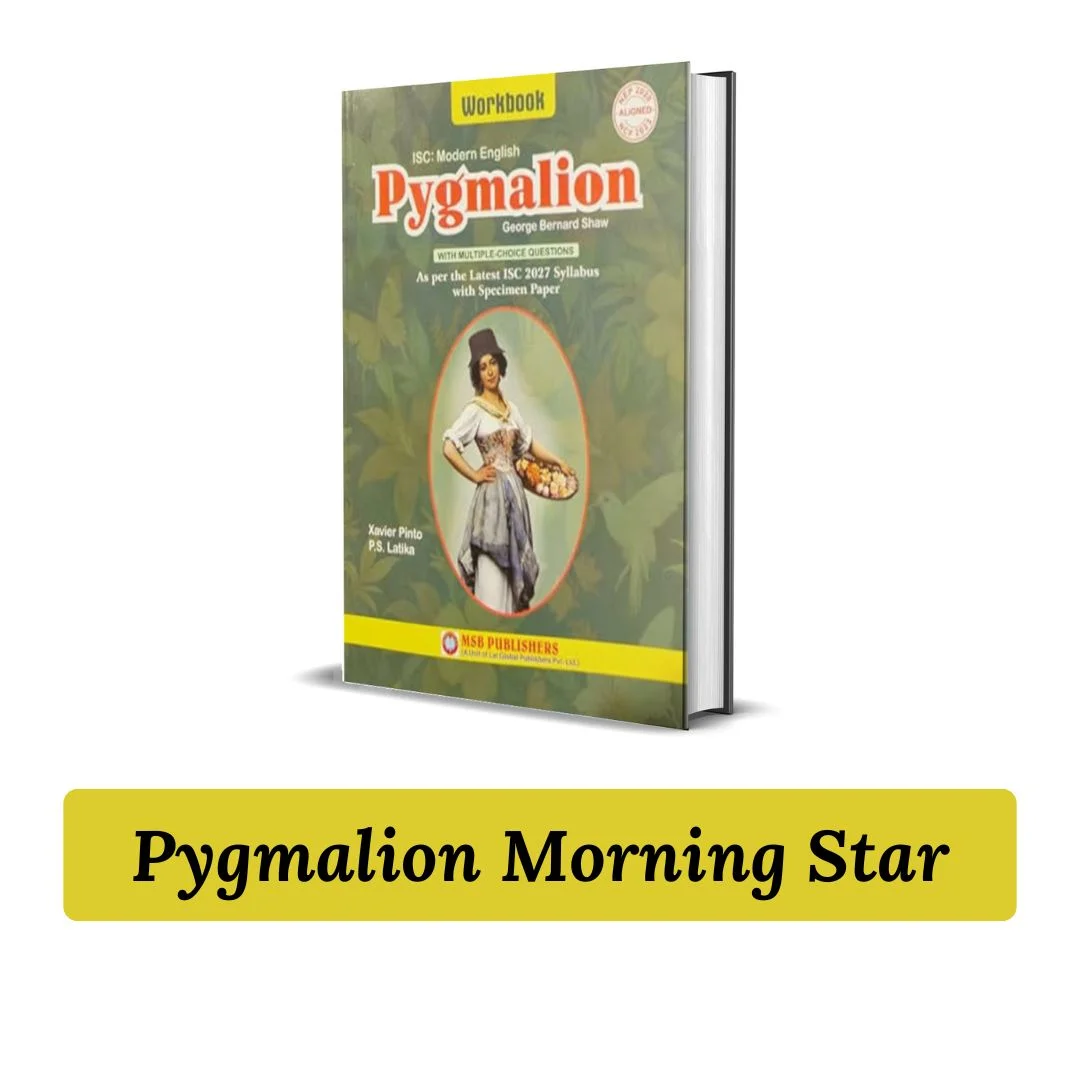

If you’re looking for accurate and easy-to-understand solutions for the Pygmalion workbook, this post on ISC Pygmalion Workbook Answer (Evergreen): Act 5 will help you prepare effectively for your ISC English Literature exams. It contains detailed answers to all the questions from Act 5 of the Evergreen Publishers workbook prescribed for ISC Classes 11 and 12. The solutions are written in a clear and exam-oriented manner to help students understand the plot, characters, important dialogues, and themes of the play. Whether you are revising for school exams or improving your literary analysis, these answers will serve as a reliable study resource.
Table of Contents
Workbook Summary
PLOT DEVELOPMENT
The scene is set in Mrs Higgins’ drawing room the next day. Early in the morning Eliza comes to her. She is now in her room in the upper storey. Later, she brings her luggage from Higgins’ house, without Higgins’ knowledge.
Mrs Higgins expects her son any time. The parlour-maid soon comes to announce Higgins’ arrival. Higgins informs his mother that ‘Eliza’s bolted’ without the customary greetings. He says that he is in difficulty, for Eliza used to look after all his things and needs. Soon Pickering also comes. He tells Higgins that the police have created a lot of difficulty and they seem to suspect them for some wrongful act. Mrs Higgins chides both of them for reporting the matter to the police. She says that they are behaving like children who are treating Eliza like their property that has been lost. Eliza, she says, has every right to go where she wants to go.
Alfred Doolittle’s arrival is announced. All are amazed to see him in a dress of a gentleman, rather a bridegroom. Doolittle says that he is going to marry his mistress. He says that the middle-class ‘morality’ forces them to marry. He is ruined. He has lost the happiness of his life. It is all the doing of Prof. Higgins who has written a letter to a millionaire and described him as “the most original moralist at present in England”. This joke of his has made the rich man leave him a legacy of three thousand pounds a year on the condition that he will lecture for his Wannafaller Moral Reform World. He has to accept the legacy as he does not want to go to a workhouse in old age. But now he is not happy as he can do no work like a common man and he has to marry like a gentleman. Earlier, he used to get money by blackmailing others; now others blackmail him for money. He had no relative in the world, but now he has fifty. He has to live for others, and not for himself-that is middle-class morality.
Mrs Higgins is glad that Doolittle has accepted the legacy, and that now he will provide for Eliza. Higgins objects to what she says. He says he (Doolittle) has sold Eliza to him, and if he is honest, he should have nothing more to do with her.
Mrs Higgins tells her son that Eliza is upstairs in the house. She adds that Eliza has told her how she has gone through a terrible ordeal, and how she used to be ignored by both Higgins and Pickering. No one thanks her for what she has done. So, out of anger, she has decided to come out of Higgins’ house, never to return.
At this moment, Eliza arrives. Doolittle is sent out to the balcony. Eliza’s ease of manners upsets Higgins. Higgins loses his temper and tells his mother, “I tell you I have created this thing out of the squashed cabbage leaves of Covent Garden : and now she pretends to play a fine lady with me.”
Eliza speaks to Pickering and expresses her gratitude to him. She says that it is from him that she has learnt good manners. Professor Higgins, no doubt, taught her out he always treated her like a flower-girl. While from the very beginning, Pickering treated her like a lady. She says that, “the difference between a lady and a flower-girl is not how she behaves but how she’s treated.” Then she announces her decision to leave them. This alarms Pickering and makes Higgins furious.
At this point, Doolittle comes into the room from the balcony. Eliza is amazed to see him dressed like a bridegroom. Doolittle tells her his story and how she and her mistress have decided to marry and live by ‘middle-class morality’. He invites Eliza and all present to come to his wedding.
Prof. Higgins and Eliza are left alone in the room for some time. There ensues heated discussion and exchange of views between them. Eliza says perhaps Higgins wants her to come back so, that she may pick up his slippers, go on errands for him and bear his temper. Higgins reply is that he will treat her as he has always treated her. If he treats a flower-girl like a duchess he will treat a duchess like a flower-girl. He has the same manners for everyone.
Higgins speaks softly and says, “I shall miss you, Eliza. I have learnt something from your idiotic notions : I confess that humbly and gratefully.” Then he tells her that he has become accustomed to her voice and presence.
Eliza asks why he has taken the trouble of ‘creating’ her if he does not care for her. Higgins asks : “Would the world ever have been made if its maker had been afraid of making trouble.” He tells her that if he wants her to come back, it is for the sheer fun of it. They can part any day. He can adopt her as his daughter. Marriage with him or Pickering is out of the question as both are ‘confirmed old bachelors’.
When Eliza tells Higgins of her decision to marry Freddy as she loves him, Higgins is amused as he has very low opinion about Freddy.
When Mrs Higgins enters the room, Eliza goes out. Higgins asks her to order a number of things for him. Eliza leaves, assuring him that she has already arranged the things he needs. The curtain falls.

Workbook MCQs
1. What does the Parlour-maid tell Mrs Higgins about Henry and Colonel Pickering?
(a) they are telephoning the police
(b) they are talking aloud
(c) Eliza is talking to them in an angry way
(d) Both of them have gone out.
Answer :-(a) they are telephoning the police
2. Mrs Higgins says to the maid, “If you had told me that Mr Henry was not in a state, it would have been more surprising.” It shows that Mrs Higgins-
(a) does not like the maid’s comment about her son
(b) is surprised at the behaviour of the maid.
(c) does not like her son’s behaviour
(d) is surprised at the change in her son’s behaviour.
Answer :-(b) is surprised at the behaviour of the maid.
3. When Higgins comes to tell Mrs Higgins about Eliza’s disappearance from his house, Eliza-
(a) is in Higgins’ laboratory
(b) has gone to her father’s house
(c) is learning her lessons with Mrs Pearce
(d) is there at Mrs Higgins’ house.
Answer :-(d) is there at Mrs Higgins’ house.
4. Doolittle says, “Who asked him to make a gentleman of me ?” It shows that he is _______
(a) asking a question
(b) expressing his anger and displeasure
(c) surprised over the situation
(d) very happy over this
Answer :-(b) expressing his anger and displeasure
5. During his long speech in front of Pickering, Alfred Doolittle says that :
(1) he objects to his being made a gentleman
(2) the doctors used to respect him when he was poor
(3) he does not have to help his relatives now.
(4) he felt free and happy earlier.
(5) earlier, he used to be poor.
Select the correct option.
(a) 2, 3,5
(b) 1, 2, 4
(c) 1, 4, 5
(d) 3, 4, 5
Answer :-(c) 1, 4, 5
6. Select the option that lists the correct relationship between Statement 1 and Statement 2.
Statement 1. After Eliza’s success at the garden party, she decides to leave Higgins’ house in anger.
Statement 2. She had become attached to Henry who never said a word of appreciation for her.
(a) Statement I is independent of Statement 2.
(b) Statement I is the result of Statement 2.
(c) Statement I is the reason of Statement 2.
(d) Statement I is an example of Statement 2.
Answer :-(a) Statement I is independent of Statement 2.
7. Mrs Higgins says, “Henry, if you really want to know where Eliza is, she is upstairs.”
Mrs Higgins’ words-
(a) surprised him
(b) pleased him
(c) annoyed him
(d) upset him
Answer :-(a) surprised him
8. Which of the following statements is NOT true of Eliza according to Act V ?
(a) Eliza is at Mrs Higgins’ house.
(b) Eliza shares with Mrs Higgins reason of her anger against Higgins.
(c) Eliza comes and weeps bitterly before Higgins to show her anger.
(d) Eliza shows great confidence during her conversation with Higgins.
Answer :-(c) Eliza comes and weeps bitterly before Higgins to show her anger.
9. Higgins tells Eliza that she can taste and smell the life of the gutter without any training. It means that Eliza –
(a) likes such kind of a life
(b) is trained by Higgins to live there
(c) is used to the life of the gutter
(d) considers any other kind of life difficult
Answer :-(c) is used to the life of the gutter
10. The Parlour-maid tells Higgins, ‘A Mr Doolittle has come to meet him’. On hearing this Higgins says, “Dolittle! Do you mean that dustman ?”
It shows his________
(a) surprise
(b) anger
(c) joy
(d) frustration
Answer :-(d) frustration
11. Doolittle says “Tied me up and delivered me into the hands of middle-class morality”. The literary device he has used here is_______
(a) metaphor
(b) paradox
(c) personification
(d) hyperbole
Answer :-(c) personification
12. Higgins calls Doolittle-
(a) an honest person
(b) an innocent man
(c) either an honest man or a rogue
(d) a millionaire and a cheat
Answer :-(c) either an honest man or a rogue
13. Select the option that is true of the assertion and the reason given below.
Assertion : Higgins believes that Eliza no longer belongs to her father.
Reason : Higgins has given five pounds to Doolittle for Eliza.
(a) Both the assertion and the reason are true and the reason is the correct explanation of the assertion.
(b) Both the assertion and the reason are true but the reason is not the true explanation of the assertion.
(c) The assertion is true but the reason is false.
(d) The assertion is false but the reason is true.
Answer :-(a) Both the assertion and the reason are true and the reason is the correct explanation of The Assertion.
14. When Liza comes downstairs and Higgins sees him there in his mother’s room, her looks and behaviour –
(a) please him
(b) frustrate him
(c) surprise him
(d) disturb him
Answer :-(c) surprise him
15. Higgins says to Eliza, “I taught it to you; and it doesn’t take me in. Get up and come home; and don’t be a fool.”
Mrs Higgins says, “Very nicely put, indeed, Henry. No woman could resist such an invitation”.
Mrs Higgins’ comment here is_________
(a) sarcastic
(b) appreciative
(c) surprising
(d) emphatic
Answer :-(a) sarcastic
16. Liza appreciates Pickering__________
(a) for his generosity
(b) for teaching her nice manners
(c) for teaching her correct pronunciation
(d) to seek his help
Answer :- For Full Workbook Answers – Get The Solutions PDF ( View )
17. Liza’s words about Higgins, “You see it was so very difficult for me with example of Professor Higgins always before me,” show that__________
(a) she respects Higgins more than Pickering
(b) Higgins was a good teacher
(c) The impact of Prof Higgins was not good on her
(d) Eliza has learnt well from Higgins.
Answer :-(c) The impact of Prof Higgins was not good on her
18. Pickering says that he does not like the word ‘experiment’ used for Eliza’s training.
It shows one of the following qualities of his character-
(a) he is an expert in Sanskrit language
(b) he is generous
(c) he is very intelligent
(d) he is humane
Answer :- For Full Workbook Answers – Get The Solutions PDF ( View )
19. According to Liza, Pickering has_________-
(a) more money than Higgins
(b) greater wisdom than Higgins
(c) greater sense of manners than Higgins
(d) no wisdom at all
Answer :- For Full Workbook Answers – Get The Solutions PDF ( View )
20. The difference between Higgins’ treatment of Eliza from the way Pickering treated her is that-
(a) Higgin’s was always scolding her but Pickering used to be kind
(b) Pickering gave her money but Higgins did not
(c) Pickering bought flowers from her whereas Higgins gave her coins
(d) Higgins treated her as a flower girl but Pickering always treated her as a lad
Answer :- For Full Workbook Answers – Get The Solutions PDF ( View )
21. Pickering asks Eliza to________
(a) forgive Higgins
(b) help Higgins
(c) learn more from Higgins
(d) respect Higgins
Answer :- For Full Workbook Answers – Get The Solutions PDF ( View )
22. In the following statement by Higgins, “She will relapse into the gutter in three weeks without me at her elbow !,” the figure of speech used by him is______
(a) symbol
(b) paradox
(c) synecdoche
(d) irony
Answer :- For Full Workbook Answers – Get The Solutions PDF ( View )
23. Select the option that lists the character traits of Mrs Higgins correctly.
1. believes in commercialism
2. is a loving mother
3. ignores her son’s follies
4. has respect for others
(a) 1 and 4
(b) 2 and 3
(c) 2 and 4
(d) 1 and 3
Answer :- For Full Workbook Answers – Get The Solutions PDF ( View )
24. Liza now has the greatest desire for________
(a) money
(b) independence
(c) becoming a great flower seller
(d) education and good manners.
Answer :- For Full Workbook Answers – Get The Solutions PDF ( View )
25. Liza says, “He has a right to if he likes, poor lad. And he does love me.” Who does the word “he’ refer to ?
(a) Pickering
(b) Higgins
(c) Freddy
(d) The Taximan
Answer :- For Full Workbook Answers – Get The Solutions PDF ( View )
26. Which of the following is the correct reason for Eliza following Higgins’ experiment, as given by her ?
(a) Eliza was a common ignorant girl who needed training
(b) She wanted new dresses
(c) She wanted Higgins to love her
(d) It was something pleasant for her to be with Higgins and she cared for him.
Answer :- For Full Workbook Answers – Get The Solutions PDF ( View )
27. What does Higgins want Eliza to give up to be treated as a lady ?
(a) the feeling of fear
(b) her honest and humble nature
(c) the feeling of being neglected if men do not flatter her
(d) the habit of always complaining against others.
Answer :- For Full Workbook Answers – Get The Solutions PDF ( View )
28. Liza says to Higgins, “Now I know how to deal with you”.
Her tone in this sentence is –
(a) full of anger
(b) surprising
(c) apologetic
(d) full of confidence
Answer :- For Full Workbook Answers – Get The Solutions PDF ( View )
29. During her conversation with Higgins at the close of Act V, Eliza appears to be_____
(a) confident
(b) humble
(c) submissive
(d) innocent
Answer :- For Full Workbook Answers – Get The Solutions PDF ( View )
30. At the end of Act V, Mrs Higgins’ complaint against her son is that he
(a) did not marry Eliza
(b) did not train her properly
(c) has spoiled the girl
(d) created problems for Freddy
Answer :- For Full Workbook Answers – Get The Solutions PDF ( View )
Complete The Sentences
1. Higgins is worried about Eliza’s sudden disappearance from his house because
Answer :- Higgins is worried about Eliza’s sudden disappearance from his house because she had gone out of his house to his mother’s place.
2. Doolittle is annoyed and angry with Higgins because
Answer :- Doolittle is annoyed and angry with Higgins because he feels that Higgins has ruined him.
3. Dolittle has got a lot of wealth from a millionaire, yet he feels sorrowful because
Answer :-Dolittle has got a lot of wealth from a millionaire, yet he feels sorrowful because now he cannot do any work like a common man.
4. The millionaire was ready to give his wealth to Doolittle because
Answer :-The millionaire was ready to give his wealth to Doolittle because he, according to Higgins, was the most original moralist at that time in England.
5. Eliza considers Pickering better than Higgins because
Answer :- Eliza considers Pickering better than Higgins because he is more gentle, tender and well mannered than Higgins.
6. Higgins says that Eliza no longer belongs to her father Mr. Doolittle because
Answer :-Higgins says that Eliza no longer belongs to her father Mr. Doolittle because he had taken from Higgins five pounds in exchange for her.
7. Higgins tells Pickering that Eliza has behaved in the most outrageous way because she
Answer :-Higgins tells Pickering that Eliza has behaved in the most outrageous way because she threw Higgins’ slippers in his face.
8. Mrs Higgins seems to justify Eliza’s throwing slippers at Higgins because
Answer :-Mrs Higgins seems to justify Eliza’s throwing slippers at Higgins because he had treated her in a brutal way.
9. Mrs Higgins asks Mr Doolittle to go to the balcony for some time and not to meet Eliza there because
Answer :-Mrs Higgins asks Mr Doolittle to go to the balcony for some time and not to meet Eliza there because she didn’t want Eliza to have the shock of her father’s news until she had reconciled with Higgins and Pickering.
10. There were several small things that, according to Eliza, Pickering did not notice at Wimple Street because
Answer :-There were several small things that, according to Eliza, Pickering did not notice at Wimple Street because they came naturally to him.
11. Liza tells Pickering that she is not blaming Higgins for not observing good manners because
Answer :- For Full Workbook Answers – Get The Solutions PDF ( View )
12. Higgins says, “My manners are exactly the same as Colonel Pickering’s”. Eliza does not agree with him and says “That’s not true”, because
Answer :- For Full Workbook Answers – Get The Solutions PDF ( View )
13. Higgins tells Eliza that he will miss her because
Answer :- For Full Workbook Answers – Get The Solutions PDF ( View )
14. Mrs Higgins is more supportive towards Eliza than her own son because
Answer :- For Full Workbook Answers – Get The Solutions PDF ( View )
15. Eliza at the end of Act V appears transformed as a woman because
Answer :- For Full Workbook Answers – Get The Solutions PDF ( View )
Short-Answer Type Questions
I. What does Higgins tell his mother about Eliza’s disappearance from his house ? What is Mrs Higgins’ response to it ?
Answer :-Henry Higgins informs his mother that Eliza had deserted him. She had run away without the customary greetings. Mrs. Higgins fears that Higgins must have scared her. But Higgins assures her that as usual, last night she switched off the lights and did other things. Then she changed her dress and left the place. She didn’t come for the night. She came back, in a cab in the morning took her things from Mrs. Pearce and went away without informing him. Mrs. Higgins is not at all surprised at Eliza’s disappearance. As if to enjoy the pleasure of irritating Higgins further, she adds that the girl (Eliza) has a perfect right to leave if she so desires.
II. What is Alfred Doolittle’s grudge against Higgins ? What does it reveal about Doolittle’s character ?
Answer :-Alfred Doolittle has a grudge against Henry Higgins. He feels that Henry has ruined him, taken away his happiness and bound him with middle class morality. In fact Henry had written a letter to an old blighter in America and recommended the name of Alfred Doolittle. The old man wanted to donate five million dollars to establish Moral Reform Societies across the world. Henry had said in his letter that Alfred Doolittle was the most original moralist at present living in England. The old man was impressed and in his will he left five million dollars for Doolittle. The man died and the Alfred Doolittle got the money. Though he has become rich now yet he is not happy. Alfred Doolittle is from a working class. He has no desire to work hard. He works as a dustman and feels contented with his lot. He lacks the desire to rise in life and be prosperous.
III. How has the death of the millionaire affected Doolittle’s life ? Is he happy with his new life ? Explain.
Answer :-The death of the American millionaire completely changed the life of Alfred Doolittle. As the man had bequeathed a lot of money to Doolittle, (three thousand dollars a year), he became very rich. He had to change his life style. Now he had to dress well and lecture for the old man’s Wannafeller Moral Reform World League as often as they asked him up to six times a year. He did not mind giving a lecture but he objected to becoming a gentleman and living under restrictions as he is a free bird by nature. He was happy and free without inhibition and prohibitions.
Alfred Doolittle is not happy with this change. Being a man of the world, he feels suffocated when he has to follow certain norms. As a poor man he had no relatives but now he has fifty such relations who want to squeeze money from him. After getting money Dolittle is unhappy because now he can’t live a life of his choice.
IV. Mrs Higgins says to her son Henry Higgins, “If you promise to behave yourself, Henry. I’ll ask her to come down.” Does Henry fulfil the promise that he will behave properly ? Explain with examples from the text.
Answer :-Observing Prof. Higgins, too eager to have Eliza back to his house, Mrs. Higgins tells him that Eliza won’t go back to Wimple Street but she is ready to meet him as a friend and forget the past events. She says to Higgins that if he promises to behave properly with Eliza she will ask her to come down. Prof. Higgins promises to behave with his best manners. Then Eliza is asked to come down. She comes and greets Higgins. Henry Higgins does not fulfil his promise of behaving well. The moment she comes, Higgins orders her to get up and come home. The language he uses is very insulting. He calls her… “the thing out of the squashed cabbage leaves of Covent garden.” Not only that when Eliza speaks he ‘grinds his teeth’ and feels like cursing her. All this shows that he has little regard for Eliza whom he regards disdainfully. After the heated discussion with Eliza, Higgins says that he wants her back but he will treat her as he had been treating her earlier. This shows he has not kept his promise.
V. Describe the way Liza expresses her gratitude towards Pickering for his with her. What does it show about Pickering ?
Answer :- For Full Workbook Answers – Get The Solutions PDF ( View )
VI. Explain Doolittle’s attitude towards middle-class morality.
Answer :- For Full Workbook Answers – Get The Solutions PDF ( View )
Long-Answer Type Questions
I. Bring out the elements of comedy of manners from Act V of Pygmalion. Whose behaviour in particular does the play criticize as an example of manners ?
Answer :- Act V of George Bernard Shaw’s *Pygmalion* strongly reflects the elements of a comedy of manners, as it satirises the artificiality, hypocrisy, and superficial behaviour of the upper and middle classes. A comedy of manners typically exposes the gap between outward social polish and inner moral emptiness, and Shaw achieves this through sharp dialogue and ironic situations.
In this act, Henry Higgins’ theory that correct speech defines social identity is ironically questioned. He believes that language and pronunciation determine a person’s place in society, yet his own behaviour contradicts the refined manners he expects from others. Despite his intelligence and education, Higgins frequently uses offensive swear words, speaks rudely, and shows little respect for Eliza. His conduct reveals that social manners are not truly about language alone but about genuine respect and human sensitivity.
Eliza Doolittle’s transformation also highlights the theme. Although she learns to speak like a duchess, she becomes aware that manners involve dignity and emotional independence, not just correct pronunciation. This exposes the hollowness of the social system that judges people based only on outward appearance.
Another important satirical element is seen in Alfred Doolittle. His sudden rise to wealth exposes the hypocrisy of middle-class morality. He criticises conventional ethics, arguing that morality is often determined by money and social position rather than genuine principles. His frank and humorous observations reveal how society pretends to uphold values that it does not truly follow.
Thus, Shaw uses Act V to criticise superficial manners, class pretensions, and moral hypocrisy. The play particularly targets Henry Higgins, whose rude and insensitive behaviour ironically contrasts with his belief in refined speech and social manners.
II. How does Eliza demonstrate that individual and independent thinking is more important than depending on others ? Does it have any relevance with teaching and learning ? Explain.
Answer :-In George Bernard Shaw’s *Pygmalion*, Eliza Doolittle clearly demonstrates that individual and independent thinking is more important than depending on others. Her transformation is not only external but also internal, as she develops self-respect and the ability to make her own decisions.
Eliza shows her independent thinking when she asserts that she will not care for anyone who does not care for her in return. This statement marks a turning point in her character, as she refuses to remain emotionally dependent on Professor Higgins, who had earlier controlled and shaped her life. Even though Higgins plays a major role in her transformation, Eliza rejects his expectation that she should continue to obey him unquestioningly.
She also firmly turns down Higgins’ request to return to him. This refusal highlights her emotional maturity and independence. Eliza no longer sees herself as a mere product of Higgins’ experiment; instead, she recognises her own worth as an individual. She desires freedom from both Higgins and her father, Alfred Doolittle, as she does not want to be treated as someone’s responsibility or possession.
Furthermore, Eliza’s decision to consider marrying Freddy Eynsford-Hill reflects her desire to build a life based on equality and mutual affection. She believes she can shape Freddy into a better person, which also shows her confidence in her own judgement and influence.
This idea has strong relevance to teaching and learning. Shaw suggests that true education should encourage independence of thought rather than blind dependence on a teacher. Just as Eliza evolves into a self-reliant individual, learners should be guided to think critically, make their own choices, and develop confidence. A teacher should act as a facilitator, not a controller, allowing students to grow into independent thinkers like Eliza.
III. Bring out the comparison between the characters and behaviour of Mrs Higgins and her son Henry Higgins on the basis of Act V of Pygmalion. Whose character appears better and why ?
Answer :-In Act V of George Bernard Shaw’s *Pygmalion*, the characters of Mrs Higgins and her son Henry Higgins are presented in sharp contrast, especially in their attitudes, behaviour, and understanding of human relationships.
Mrs Higgins appears wise, balanced, and emotionally mature. She acts as a voice of reason when Henry Higgins and Colonel Pickering behave irresponsibly after Eliza’s arrival. She firmly tells them to stop acting like children, showing her superior judgement and calm authority. Mrs Higgins also understands Eliza’s emotional state and asserts that Eliza is not their possession or experiment. She strongly supports Eliza’s right to live independently and make her own decisions. Her attitude reflects sensitivity, practicality, and a deep sense of justice.
On the other hand, Henry Higgins is portrayed as proud, self-centred, and possessive by nature. He treats Eliza more as an object of his linguistic experiment than as a human being with feelings. His behaviour is often rude and authoritative, and he tends to sneer at others without considering their emotions. Even after Eliza’s transformation, he fails to acknowledge her independence and expects her to return to him without recognising her personal growth. This reveals his lack of emotional maturity despite his intellectual brilliance.
In comparison, Mrs Higgins’ character appears far superior. She is more sensible, compassionate, and practical in her approach to life. While Henry Higgins is intellectually gifted, he lacks emotional understanding and social grace. Mrs Higgins, however, combines wisdom with empathy and stands up for dignity and independence, especially for Eliza.
Thus, Shaw uses Mrs Higgins to represent moral balance and social awareness, making her character more admirable than that of her son. Her ability to see Eliza as an independent individual makes her the most impressive and reasonable character in Act V.
IV. Discuss the reasons for Eliza not marrying Higgins. Is Higgins’ mother also a hindrance in their marriage ? How do you know ?
Answer :-In George Bernard Shaw’s *Pygmalion*, Eliza Doolittle does not marry Henry Higgins due to differences in personality, emotional understanding, and mutual respect. Although Eliza is intelligent and learns quickly under Higgins’ guidance, becoming capable of speaking correct and refined English, her transformation leads her to greater self-awareness rather than emotional dependence on him.
Eliza ultimately refuses to marry Higgins because she is sensitive and self-respecting. She realises that Higgins, despite being intellectually brilliant, lacks basic manners and emotional consideration. He often ignores her feelings, treats her harshly, and behaves like a bully rather than a companion. Eliza understands that living with such a man would mean constant emotional distress and a lack of dignity. Therefore, she decides that marriage with Higgins would not bring her happiness or equality.
Another important factor is Higgins’ attitude towards Eliza. He continues to see her as a product of his experiment rather than as an independent individual. This makes Eliza feel devalued and unimportant, further strengthening her decision to separate from him.
Mrs Higgins also plays a significant role as a hindrance in the possibility of their marriage. She clearly disapproves of her son’s behaviour and does not support the idea of Eliza becoming part of his life. From Mrs Higgins’ perspective, Eliza is not suited to the expectations and ideals that she associates with her son’s household and social position. Her practical and realistic outlook highlights that such a relationship would not be appropriate or harmonious.
Thus, Eliza’s refusal is based on her self-respect, Higgins’ insensitive nature, and the lack of emotional compatibility. Mrs Higgins’ disapproval further reinforces the idea that a marriage between Eliza and Higgins is neither suitable nor desirable.
V. Does Act V provide a proper ending to the play ? Give arguments in support of your answer.
Answer :-Act V of George Bernard Shaw’s *Pygmalion* provides a fitting and logical ending to the play, as it completes Eliza Doolittle’s transformation and resolves the central conflict of identity, independence, and social class.
In this act, Mrs Higgins accompanies Eliza to Alfred Doolittle’s marriage, which serves as a symbolic background to Eliza’s own emotional turning point. Eliza is now free from her earlier subjugation and dependence on Professor Higgins. She has gained confidence, dignity, and self-awareness after her training in speech and manners. For Full Workbook Answers – Get The Solutions PDF ( View )
VI. How does Act V bring out the theme of transformation ? Give examples from the text.
Answer :-Act V of George Bernard Shaw’s *Pygmalion* clearly brings out the central theme of transformation, especially through the character of Eliza Doolittle. The act shows that her transformation is not merely external but also intellectual, emotional, and psychological.
Eliza, who was once a poor flower girl with unrefined speech, has been fully transformed after her education under Professor Higgins. She is now intelligent, self-respecting, and highly conscious of her individuality. Her refined speech is only a surface change; the deeper transformation lies in her thinking and awareness of her own worth as a human being. For Full Workbook Answers – Get The Solutions PDF ( View )
Specimen Solution - Act 5
Question 1
I. Why are Higgins and Pickering calling the police when they arrive at Mrs Higgins’ house ?
(a) to report Eliza’s disappearance
(b) they want the police to control Mr Doolittle
(c) Mrs Higgins has asked them to report against Eliza
(d) they want the police to bring Eliza back from Mrs Higgins’ house.
Answer :-(a) to report Eliza’s disappearance
II. Which of the following statements is NOT true about Mrs Higgins’ words about Eliza ?
(a) Eliza is there in the upper room of her house.
(b) She will call Eliza downstairs if Higgins agrees to be decent towards her (Eliza).
(c) Eliza is not allowed to leave without Mrs Higgins’ permission.
(d) Eliza has the right to leave Higgins’ house whenever she wants.
Answer :-(c) Eliza is not allowed to leave without Mrs Higgins’ permission.
III. At the end of Act V, Eliza_____
(a) is completely independent
(b) remains under the influence of Higgins
(c) is confused about her position in Mrs Higgins’ house
(d) gets married to Pickering
Answer :- For Full Workbook Answers – Get The Solutions PDF ( View )
IV. What is the difference that Mrs Higgins finds between Henry Higgins and Eliza?
(a) Eliza is a better teacher than Higgins
(b) Higgins is not so intelligent as Eliza
(c) Eliza has acquired greater social status than Higgins.
(d) Eliza has better manners than Higgins.
Answer :- For Full Workbook Answers – Get The Solutions PDF ( View )
Question 2
I. Higgins claims that Eliza belongs to him because
Answer :-Higgins claims that Eliza belongs to him because he has created her out of the squashed cabbage leaves of Convent Garden.
II. According to Act V of the play, a change in speech and outlook is not enough to create a new identity because
Answer :-According to Act V of the play, a change in speech and outlook is not enough to create a new identity because speech sounds and outlook cannot transform a person in totality.
III. Eliza tells Pickering that without his presence it would have been difficult for her to learn nice manners because
Answer :- For Full Workbook Answers – Get The Solutions PDF ( View )
IV. Eliza says that she’ll always be a flower-girl to Higgins because
Answer :- For Full Workbook Answers – Get The Solutions PDF ( View )
Question 3
I. Bring out the significance of the difference that Eliza notices between Pickering and Higgins. How is it related to the theme of the play ?
Answer :-Eliza noticed it from the beginning that Higgins treated her, not as a human being but as an object of experiment. His purpose was to teach Eliza good manners, speech sounds, good pronunciation and to transform her whole personality. But he always treated her as an object picked up from the squashed cabbage leaves of Covent garden to win a bet. But Pickering treated her respectfully like a lady. Eliza feels that the difference between a flower girl and a lady is not how she behaves but how she is treated. This difference between how a lady is treated and how a flower girl is to be treated is related to the theme of the play. The play is a satire on middle class morality. The poor flower girl who lacks manners is unable to get a job as assistant at a shop. She is discriminated against by people due to her lower class status. But when the same girl learns manners necessary for middle class people she is readily accepted as the duchess.
II. What do you understand about Higgins and Pickering’s treatment of Eliza from Mrs Higgins’ conversation with them ? What is Mrs Higgins’ understanding about it ?
Answer :-Both Higgins and Pickering treat Eliza as an object which is their property. No wonder when she disappears one day they report the matter to the police and expect that she should be immediately found as if she were an umbrella or something like it. Mrs. Higgins is unhappy with both of them for behaving in this (childlike) manner. She says to Higgins that if Eliza has ‘bolted” he must have frightened her. But Higgins calls it nonsense. Higgins is very upset because he can’t find anything and he knows nothing about his appointments for the day. Like a wise lady Mrs. Higgins tells them that Eliza has a perfect right to leave if she chooses. She is angry with Higgins. She feels that Higgins has no right to give the girl’s name to the police as if she were a thief or a lost umbrella. She considers the action of Higgins and Pickering as childlike and devoid of mature thinking.
III. (a) ‘Pygmalion shows that social identity is related to much more than one’s language and speech only’. Explain with reference to the text of the play.
Answer :-In George Bernard Shaw’s *Pygmalion*, it is clearly shown that social identity is related to much more than one’s language and speech. Although correct pronunciation and refined speech play an important role in determining how a person is perceived in society, Shaw highlights that identity is also shaped by dress, manners, behaviour, and social acceptance. For Full Workbook Answers – Get The Solutions PDF ( View )
(b) Bring out the dramatic significance of the long conversations between Eliza and Higgins. What do these conversations reveal about the change that Higgins has undergone ?
Answer :- In George Bernard Shaw’s *Pygmalion*, the long conversations between Eliza and Henry Higgins in Act V are highly dramatic and significant, as they reveal the emotional and psychological changes in both characters after Eliza’s transformation.
These dialogues clearly show that Eliza has undergone a complete transformation. She is no longer the timid flower girl she once was. Instead, she now displays independent thinking, confidence, and self-respect. She is able to argue with Higgins on equal terms and openly expresses her feelings and grievances. Eliza firmly asserts her right to make her own decisions and refuses to be treated as a mere object or experiment. This marks her growth into a strong, self-reliant individual. For Full Workbook Answers – Get The Solutions PDF ( View )